If you manage procurement or product development for a growing brand, your inbox is likely a mess of overlapping threads. You have your graphic designer asking for die-lines, a factory overseas asking for color approvals, and a freight forwarder telling you a shipment is delayed.
When packaging is treated as a series of disconnected steps handled by different vendors, the brand absorbs all the risk. If a box arrives crushed, the manufacturer blames the logistics team, the logistics team blames the structural designer, and you are left paying for the reprint.
This is exactly the problem a one-stop packaging solution is designed to solve.
What is a one-stop packaging solution, and when does a brand actually need one?
A one-stop packaging solution means one partner is accountable for structure, materials, sampling, production, quality control, and shipping, instead of the brand coordinating each vendor itself. It pays off when those decisions affect each other: custom structures, multi-component kits, premium finishes, overseas production, or a fixed launch date.
- •Applicable conditions: worth it when a change in one stage (board caliper, insert fit, carton size) forces changes in another. A simple reorder of standard packaging with no design or logistics questions usually doesn’t need it.
- •Key trade-off: the line-item quote may be higher than the cheapest factory’s, and early structure review adds time up front. What you buy back is fewer handoffs, fewer sampling rounds, and one party responsible when something fails.
- •Verification step: before signing, ask who owns the dieline after prototype approval, who signs off the production sample, and who pays if the first run fails transit or assembly. Vague answers usually mean a broker.
If you are still comparing whether to manage suppliers separately or consolidate the workflow, it helps to first understand how custom packaging design and manufacturing connects structure, materials, sampling, production, and logistics.
This video summarizes the key ideas from the full article and can be watched as an educational guide or listened to like a podcast for a quick overview.
What Is a One-Stop Packaging Solution?
A one-stop packaging solution is a service model where one partner manages your packaging from structural design and material selection through sampling, production, quality control, and shipping, and answers for how those stages fit together.
Instead of acting as the general contractor between a designer, a sample maker, a printer, and a freight forwarder, you give one team the brief and hold it accountable for the result. That doesn’t mean every step happens under one roof. It means one party owns the specifications, signs off each stage, and fixes the problem when something doesn’t match.
What a One-Stop Packaging Solution Is Not
A one-stop packaging solution is not the same as contract packaging or co-packing. Contract packaging usually focuses on packing, labeling, kitting, or fulfillment tasks after the product is already made. A one-stop custom packaging partner focuses on developing and manufacturing the packaging itself, including structure, materials, dielines, sampling, production, QC, and logistics. Some one-stop partners also take on kitting, which can remove a separate co-packer from the chain, as in the enCore project below. The difference is responsibility: a co-packer assembles the parts it receives, while a one-stop partner also answers for how those parts were specified and made.
It is also not the same as working with a broker. A broker may coordinate factories, but may not control engineering, production standards, material decisions, or quality risk directly.
Why Brands Are Consolidating Packaging Suppliers
Most brands don’t consolidate because managing several vendors is tiring. They consolidate after a problem that nobody could own: an insert that fit the sample but not the production run, or a carton that passed design review and failed in transit.
Single Source of Accountability
With one partner, the question “whose problem is this?” has one answer. If the insert doesn’t hold the product or the foil stamping flakes, you don’t need to work out whether the designer, the printer, or the converter caused it. That only works if the contract says so: confirm in writing which defects the partner will remake at its own cost.
Fewer Handoffs, Faster Launches
Each handoff between vendors, say from an independent designer to a factory, adds a round of file conversion, questions, and re-quoting. When the people designing the structure already know the production equipment, they design within its limits from the start, so fewer revisions come back from the factory. You still go through sampling; you just tend to need fewer rounds of it.
Where the Cost Savings Actually Come From
One partner rarely means the lowest unit price. The savings come from what stops happening: duplicate markups between a broker and a factory, freight between intermediate facilities, and sampling rounds caused by files changing hands. Whether that outweighs a cheaper line-item quote depends on how many coordination points your project has; start with total landed cost rather than unit price. The full cost case, including when separate specialist vendors still make sense, is in how a one-stop custom packaging supplier compares with splitting work across vendors.
Vendor count is not the only cost lever. Re-engineering STIIIZY’s two-piece rigid box into a paper sleeve with a redesigned inner tray reduced its overall packaging cost by 20%. The STIIIZY case study shows how the sleeve tolerances were set.
Fragmented vs. One-Stop Procurement
| Feature | Fragmented Supply Chain | One-Stop Partner |
| Vendor management | You coordinate 3–5 companies | One main contact coordinates the stages |
| Quality control | Often found at final delivery | Checked at sampling and during production |
| Accountability | Split between vendors | One party answers for the result |
| Line-item price | Often lower per component | Often higher on the quote |
| Lead time risk | Handoffs add delay | Fewer handoffs, but you depend on one partner’s capacity |
| Best fit | Simple reorders, in-house packaging engineers | Custom structures, kits, fixed launch dates |
The Standard Turnkey Packaging Process
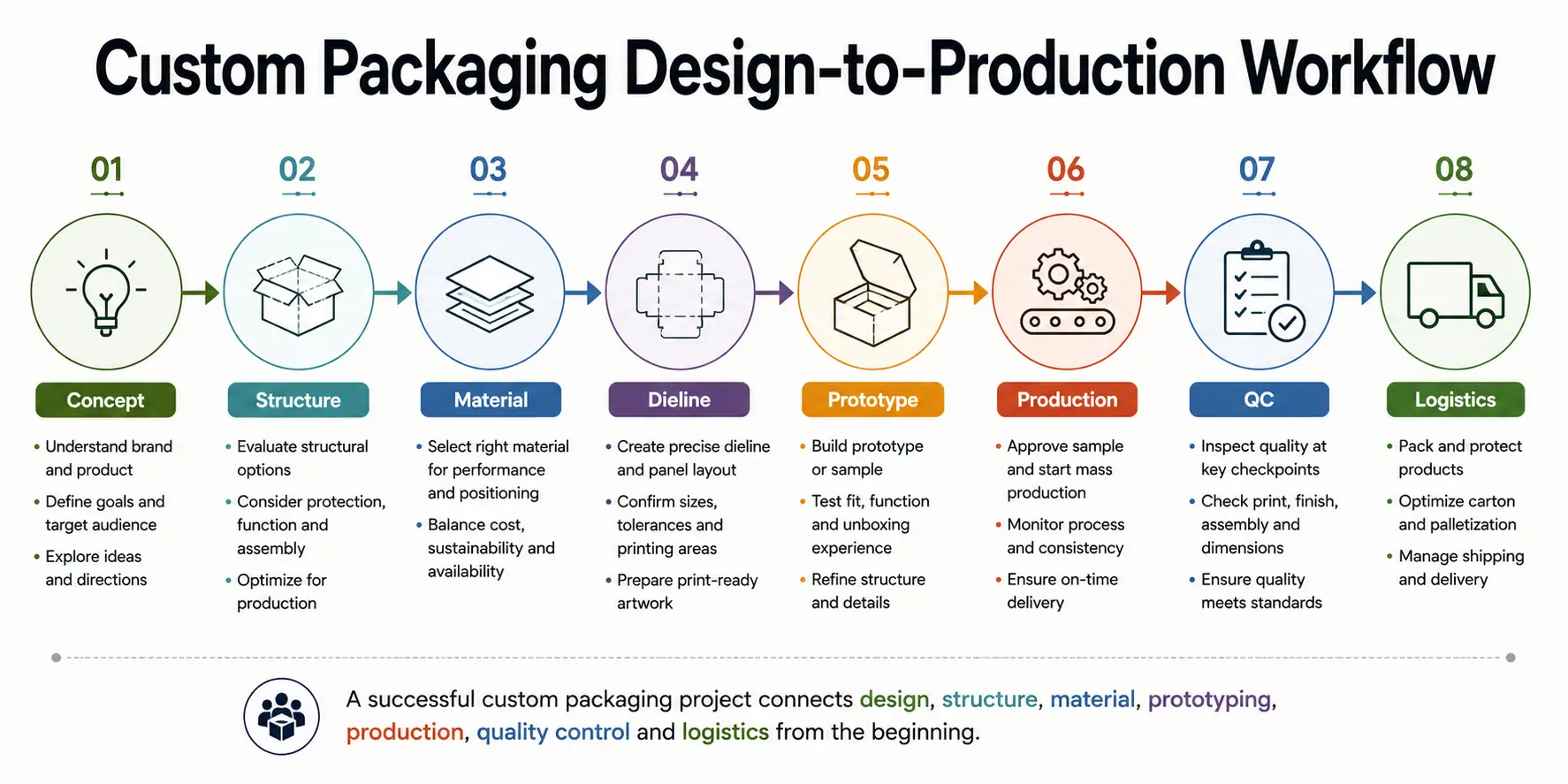
What exactly happens when you hire a full-service packaging company? While every project is unique, a mature supplier will guide you through a standardized workflow:
- Consultation and Structural Engineering: The partner analyzes your product’s dimensions, weight, fragility, and retail environment. They create a structural design (the die-line) that protects the product while minimizing material waste.
- Prototyping and Material Selection: You receive a blank physical sample to test the fit and feel. At this stage, the partner advises on paper weights, corrugated board grades, or sustainable alternatives. For a deeper checklist, see our packaging sampling guide before approving any sample for production.
- Graphic Application and Pre-Press: Your artwork is applied to the die-line. The partner ensures colors are calibrated for the specific printing presses that will be used. If your design team is preparing artwork, make sure they understand the role of a packaging dieline before applying graphics to the flat template.
- Mass Production and QC: The packaging is printed, cut, glued, and assembled. A dedicated quality control team inspects the run for color consistency, structural integrity, and finishing defects. Print quality also depends on selecting the right packaging printing techniques for the material, order quantity, and finishing effect.
- Logistics and Fulfillment: The final goods are flat-packed or fully assembled and shipped directly to your fulfillment center or manufacturer.
What Decisions Does a Brand Make at Each Stage?
Whether you consolidate suppliers or not, every custom packaging project passes through the same five decisions. A one-stop partner doesn’t remove them; it makes sure the answer at one stage doesn’t quietly break the next.
1. Should you consolidate at all? The question isn’t how many suppliers you use but how many handoffs your team can manage without losing information between them. What fragmented packaging sourcing really costs walks through where those handoffs fail.
2. Which supplier can carry the project? Direct factories, brokers, and full-service partners carry different levels of accountability. Use how to evaluate custom packaging suppliers to test engineering depth before you compare prices.
3. What goes into the request for quote? A quote is only as accurate as the spec behind it. See how to request a custom packaging quote and what goes into a custom packaging quote.
4. When is a sample ready for production? A hand-made sample proves the concept, not the production run. The packaging sampling guide and the prototype-to-production guide cover what to check before approval.
5. What will this packaging really cost to own? Stock components or custom tooling, low MOQ or lower unit price: these trade-offs only make sense against total landed cost and the stock-versus-custom decision matrix.

When Does a Brand Need a One-Stop Packaging Partner?
A one-stop packaging model is especially useful when the project involves custom structure, multiple packaging components, overseas production, tight launch timelines, premium finishes, e-commerce shipping protection, or several vendors that need to coordinate with each other.
It may be less necessary for very simple reorder projects using standard packaging with no design, structural, or logistics complexity.
How to Evaluate a One-Stop Packaging Partner
“One-stop” describes who owns the outcome, not who owns the machines. Most packaging partners, one-stop or not, work with converters and specialist factories for some components. The difference is whether the partner controls the engineering, the specifications, and the quality checks, or simply passes your order along.
These questions tend to reveal which one you’re talking to:
- Who draws and revises the dieline? Ask to see how a structural change was handled on a past project. If only graphic designers are involved, structure and shipping cost are being left to the factory.
- What sample will you approve before production? A blank structural sample, a printed sample, and a production sample answer different questions. Ask which ones are included and who pays for extra rounds.
- Where is each component made, and who inspects it? You don’t need one factory. You need to know who checks the work before it ships.
- How is color controlled between the proof and the run? Look for a defined method (a target standard, a tolerance, and who signs off), not just “we match your Pantone.”
- Where does their responsibility end? Ex-factory, at the port, or at your warehouse. The answer changes how you compare quotes.
If you are comparing suppliers, ask whether they can explain machine production, hand assembly, material risk, QC, and logistics impact—not just quote a low unit price. This is also why a transparent custom packaging quote from overseas suppliers should include more than unit cost.
Who Owns Testing and Compliance in a One-Stop Model?
Consolidating suppliers doesn’t transfer regulatory responsibility. The brand that sells the product remains responsible for meeting the rules in its market. What a one-stop partner can own is the coordination: making sure the structure, materials, and production run match what was actually tested.
That distinction matters most in two places. For transit performance, ask whether the packaging will be tested to a recognized protocol such as ISTA, who arranges the test, and whether the tested sample came from the production line or was hand-made. For child-resistant packaging in the US, the test method is defined in 16 CFR 1700.20. The CPSC doesn’t approve specific packaging, so the useful question is which exact closure, container size, and configuration a test report covers, not whether a supplier calls a component “certified.”
At INNORHINO, these tests are arranged through independent third-party laboratories, and lab fees are quoted separately from packaging production. That keeps the test result independent of the supplier and makes the cost visible before you commit to it.
A partner who handles structure and production can also catch the most common gap: a change made after testing (a different liner, a thicker board, a new insert) that the test report no longer covers. Ask how revisions after testing are flagged and who decides whether a retest is needed.
What a One-Stop Project Looks Like: The enCore Impression Kit
enCore Guards is a US dental lab brand that sells a mail-in kit for custom night guards on Amazon and its own online store. The kit already sold on both channels, but it was built from six separately sourced parts: printed materials, a bag, a tray, a bubble mailer, impression putty, and the box. The parts then went to a US co-packer for kitting before moving on to enCore’s warehouse.

That setup carried the risks described above. If any one part arrived late, no kits could be assembled or shipped. The box bulged and would not close flat, loose parts rattled in transit, and every kit needed a hand-applied QR sticker. Each problem sat at a handoff between suppliers, so no single vendor owned it.
INNORHINO took over sourcing and production for every component and moved kitting into its own facility. Finished kits now ship to enCore’s warehouse on one invoice, which removed the US co-packer and one domestic freight leg. With the whole kit under one team, the work could target what was driving fulfillment cost:
- A fixed place for every part. The bag, guard case, blister-sealed tray, and tamper-evident putty box sit in one custom mailer box, which now closes flat without rattling.
- An Amazon box sized to the fee threshold. enCore’s fee analysis showed dimensional weight was setting the Amazon fee. Taking 0.2 inches off one side, from 10.5 × 9.5 × 1.75 to 10.5 × 9.3 × 1.75 inches with the same materials, met the 173.75 in³ target, for an estimated saving of US$0.35 per unit, or about US$3,500 per 10,000 units.
- A lighter storefront kit. The storefront version was reconfigured to 428 g, under the 1 lb threshold, with an estimated 30–40% lower shipping cost per order.
- QR codes printed on the pack. Variable printing on the postcard replaced the hand-applied sticker.
The savings are estimates from enCore’s fee analysis; actual results depend on production dimensions, carrier rates, and shipping zones. Neither the 0.2-inch change nor the kitting move would have come out of a quote comparison. Both depended on one party seeing the box, everything inside it, and each channel’s fees at the same time.
Read the full enCore packaging case study.
3 Common Mistakes When Switching to a Single Supplier
If you are transitioning to a consolidated model, watch out for these pitfalls:
- Skipping the prototype phase: Never approve mass production based solely on a 3D digital render. Always demand a physical, unprinted structural sample to test with your actual product. This is one of the most common packaging sampling mistakes brands make before mass production.
- Choosing based on unit price alone: A lower price per box can disappear quickly. If even one run in ten has to be partly reprinted, or the carton size pushes shipping into a higher rate bracket, the savings are gone. Compare quotes on total landed cost, not unit price.
- Bringing packaging in too late: Brands often finalize their product and only think about the box weeks before launch. By then the box has to fit a locked product, which can mean extra dead space, more void fill, or a larger carton that pushes shipping into a higher rate bracket. A structure change at that stage also restarts sampling, which can move the launch date. Engage your packaging partner during product development so the box and the product are sized together.
How INNORHINO Simplifies the Packaging Supply Chain
INNORHINO’s structural engineers and production teams work on the same project file, so the team that designs the dieline is the team that answers for how it runs on the line. That is the part of one-stop that matters: not the number of services on a list, but whether one team can explain why a structure was chosen and what changes if the material, quantity, or shipping method changes.
For projects that require structure, material, artwork, sampling, production, and logistics to work together, our packaging design and engineering support helps turn packaging ideas into production-ready solutions.
If you’re about to compare suppliers or approve a first prototype, The Packaging Engineering Blueprint collects the decision matrices and supplier evaluation questions from this guide in one place, along with the cost traps we see most often before mass production.
A one-stop model is worth paying for when your packaging decisions depend on each other and nobody on your team owns the connections between them. It is less useful for a simple reorder of a box you already know works.
The evidence is usually in the details a single owner catches. At enCore, moving six suppliers and a co-packer to one partner made it possible to take 0.2 inches off the box and put a potential US$3,500 fulfillment saving per 10,000 units on the table. The opposite also happens: a $245 saving on a cheaper stock carton turned into $5,950 of extra freight exposure, because the carton change was decided without the shipping profile in view.
Frequently Asked Questions (FAQ)
Does a one-stop solution cost more than managing suppliers myself?
Can I use my own graphic designer?
How is a one-stop packaging partner different from a co-packer?
How can I tell a one-stop partner from a broker?
Is a one-stop model worth it for small orders?
Ready to Streamline Your Packaging?
If your packaging project involves design, structure, sampling, production, and logistics, you do not have to manage every handoff alone. Share your product details, launch timeline, and packaging goals with our team. We can help you review the right structure, material, production route, and sourcing plan before the project becomes expensive to change.