Match the paper format to the job the plastic was doing: honeycomb paper wrap instead of bubble wrap, corrugated honeycomb pads instead of EPS blocks for heavy items, and die-cut corrugated inserts instead of EPE foam for fixed product positioning. Paper does not rebound like foam, so the switch only holds if protection is retested.
- Bubble wrap → Honeycomb paper wrap
For small to mid-weight items wrapped one by one. - EPS foam blocks → Corrugated honeycomb pads
For heavier products that need support and bracing. - EPE foam trays → Die-cut corrugated inserts
For lighter products that need to sit in a fixed position.
Before you switch: paper crushes instead of bouncing back like foam. Retest with the real product on your actual shipping route, and compare cost per shipped unit, not insert price.
Think twice if: the product is heavy and fragile, the route is humid, or the surface is sensitive to paper dust.
Most requests to get rid of the foam start with a reasonable goal: customers complain about plastic in the box, a retailer asks for plastic-free packaging, or the brand wants an all-paper pack that is easier to recycle. The harder question comes next. The plastic insert was doing a specific job, and the paper replacement has to do the same job on the same shipping route.
This guide covers three common sustainable packaging inserts, where each one works, where it struggles, and what to test before you commit to a production order.
What Changes When You Replace Plastic with Paper
Foam and air-based plastics absorb impact and then largely recover their shape. Paper structures absorb impact by crushing, and once crushed, most of that cushioning is gone. For a parcel that takes one or two hard drops, that difference may not matter. For a heavy, fragile product on a multi-touch route, it can decide whether the product arrives intact.
Three other differences tend to affect the decision:
- Moisture. Paperboard loses stiffness in humid conditions. Sea freight, non-climate-controlled warehouses, and humid destination markets all deserve attention.
- Volume. To match the protection of a thin foam layer, a paper insert often needs more thickness or a larger carton. That affects dimensional weight, carton count per pallet, and freight cost.
- Pack-out. A wrap that a packer tears and wraps by hand, a pad dropped into a carton, and a die-cut insert that needs folding each take different amounts of labor time.
None of this rules paper out. It means the replacement should be engineered for the product and route rather than swapped one for one.
1. Honeycomb Paper Wrap Instead of Bubble Wrap

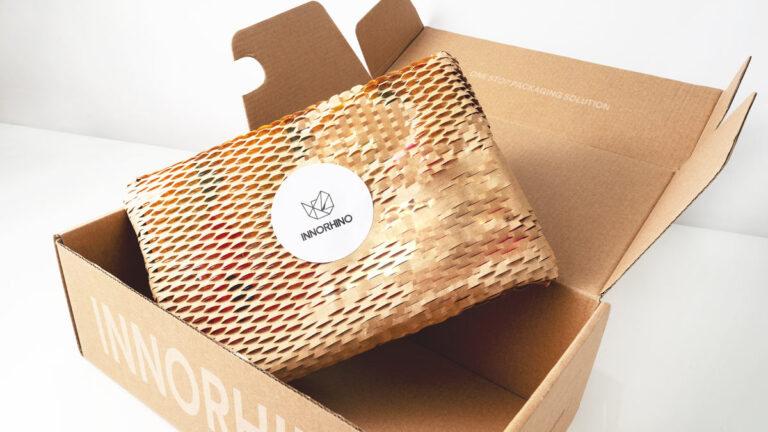
Honeycomb paper is kraft paper die-cut so that it stretches into a three-dimensional hexagonal mesh. Wrapped around an item, the cells lock onto each other and form a cushioning layer without tape.
Where it fits: individually wrapping glassware, ceramics, candles, bottles, and other small to mid-weight items shipped in a carton or mailer. It also suits brands that want the unboxing to read as paper-only.
Where it struggles: it provides less cushioning per layer than bubble wrap, so heavier or more fragile items usually need several layers or a second form of protection. It also does not hold an item in a fixed position on its own. If the product can still move inside the box after wrapping, the carton size or the internal structure needs to change.
What to check: the number of layers needed to pass your drop test, the effect on carton size, and the wrapping time per unit compared with your current process.
This short video shows how honeycomb paper expands and wraps around a product:
2. Corrugated Honeycomb Pads Instead of EPS Blocks

Corrugated honeycomb board places a hexagonal paper core between two paper liners. The result is a rigid, lightweight panel that resists crushing well across its face. It can be cut into pads, corner blocks, edge protectors, and spacers.
Where it fits: heavier products where EPS blocks currently provide support and bracing, such as small appliances, electronics, lighting, and furniture components. It also stacks flat, which can reduce inbound storage space compared with molded EPS.
Where it struggles: EPS is often molded to match the product’s contours. Honeycomb board is cut from flat panels, so complex shapes need multi-piece assemblies that take longer to pack. Like any paper structure, it can lose strength under prolonged humidity.
What to check: compression and drop performance with the real product weight, the number of separate pieces the packer must handle, and whether the pads stay in place during vibration.
3. Die-Cut Corrugated Inserts Instead of EPE Foam

Die-cut corrugated inserts are folded paperboard structures that hold each product in a fixed position. They replace the cut or CNC-routed EPE foam trays common in cosmetics kits, accessories, and gift sets.
Where it fits: lighter products in mailer boxes or retail cartons, where the insert’s main job is positioning and presentation rather than heavy shock absorption. The insert can be printed and designed as part of the unboxing.
Where it struggles: EPE foam holds irregular shapes snugly and absorbs repeated small impacts. Corrugated inserts work best with products that have stable, predictable dimensions. They also need a cutting die, so small runs or frequent product changes carry tooling and revision cost.
What to check: product fit tolerance (a loose fit lets items rattle and scuff), fold and assembly time, paper dust on products with open surfaces, and whether the die can serve more than one SKU. For board and flute choices, see our guide to corrugated flutes and board strength.
If none of these three fits, molded pulp is often the next option to evaluate. It can follow product contours more closely, but requires its own tooling and longer development time.
Sustainable Packaging Inserts Compared
| Current plastic insert | Paper alternative | Works well when | Reconsider when | Test before switching |
|---|---|---|---|---|
| Bubble wrap | Honeycomb paper wrap | Small to mid-weight items, wrapped individually | Heavy or very fragile items, or products that still move after wrapping | Layers needed to pass drop test, wrap time |
| EPS blocks | Corrugated honeycomb pads | Heavier products needing support and spacing | Complex contours, long humid exposure | Compression, drop, and vibration with real weight |
| EPE foam trays | Die-cut corrugated inserts | Lighter products with stable dimensions, presentation matters | Irregular shapes, very small runs, frequent SKU changes | Fit tolerance, assembly time, dust, die reuse |
What Regulations Actually Require
An earlier version of this article said EU single-use plastic bans require brands to drop bubble wrap and foam. That overstates the rule. The EU Single-Use Plastics Directive bans specific items such as plastic cutlery, plates, straws, and expanded polystyrene food and beverage containers. It does not ban protective packaging such as bubble wrap, EPS blocks, or EPE foam inserts.
The rules that matter more for inserts are newer and focus on how much packaging you use:
- EU PPWR. The Packaging and Packaging Waste Regulation (EU) 2025/40 has applied since August 12, 2026. It includes packaging minimization requirements and a future empty-space limit for grouped, transport, and e-commerce packaging. Loose fill such as bubble wrap, air pillows, foam chips, and paper fill counts as empty space, so replacing plastic filler with paper filler does not fix an oversized box. For brands shipping into the EU, see our guide to what PPWR means for U.S. brands.
- U.S. environmental claims. If you plan to call the new insert compostable, biodegradable, or recyclable, the FTC Green Guides require evidence for the claim and qualification when facilities are not widely available. Some states, including California, have added stricter rules on recyclability claims.
In short, switching to paper can support a plastic-reduction goal, but it does not by itself make a package compliant. Right-sizing the carton often matters as much as the insert material. An all-paper pack can also simplify recycling, though moving to a single material has its own production trade-offs, covered in our article on mono-material packaging.
How to Validate the Switch
- Define what the current insert is protecting against. Review damage records by SKU and route. If you have none, note the product weight, fragile points, and shipping method.
- Shortlist by product, not by material preference. Use the comparison above to narrow to one or two paper formats, and decide whether the carton size can change.
- Prototype with the real product. Sample inserts should be tested with production units, not dummies, because fit tolerance drives most corrugated insert failures.
- Run a transport test that reflects your route. A parcel test such as an ISTA procedure is a common starting point. Pick the procedure that matches how the product actually ships, and test the current plastic pack alongside the paper version so you have a baseline.
- Time a pack-out trial. Have the people who will pack the order assemble a batch. Wrapping and folding time can offset material savings.
- Compare cost per shipped unit. Include insert cost, carton size, freight, storage, labor, and expected damage. A cheaper insert in a larger box can cost more overall. Our article on the hidden supply chain costs of sustainable packaging explains how to frame this comparison.
If the paper version passes on protection but adds labor, that may still be the right decision. It is better made with the numbers in hand than discovered after launch.
Planning a Plastic-Free Insert?
If you are considering a switch, send us your product dimensions and weight, your current insert and carton, how the product ships, and any damage records you have. We can help narrow the options, develop samples, and plan the testing scope before you commit to production. Third-party transport testing is arranged through outside laboratories and quoted separately.
Talk with us. Let’s shape it together.