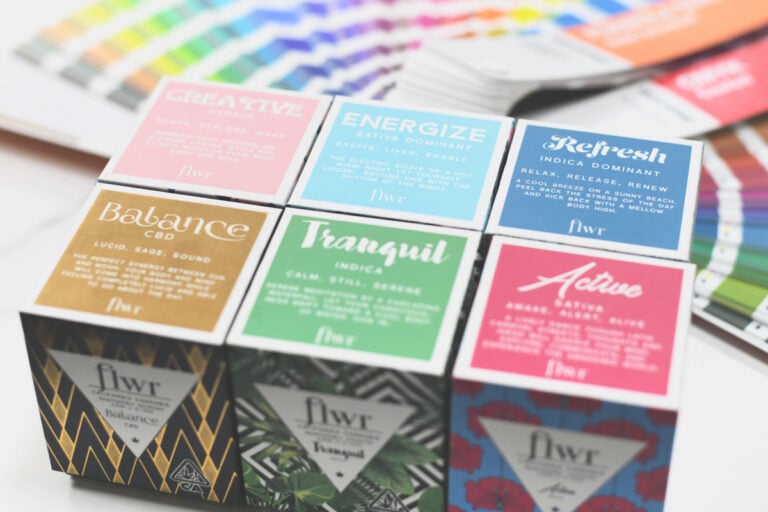
What do you need to send an overseas supplier to get a custom packaging quote you can actually compare?
Send a spec sheet with dimensions, material, finishes, and quantity, then ask for two prices: one at EXW or FOB for the factory cost, and one DDP for the landed cost. Confirm whether the MOQ applies per order or per SKU, and approve a physical pre-production sample before you pay the production deposit.
A single all-in price is fine for a first order if you don’t work with a freight forwarder, but it hides where the money goes. When you compare suppliers, line up the factory prices first, then check each landed figure against your own forwarder’s quote. Ask each supplier when the production clock starts, which should be after sample approval, then add transit and a buffer of your own.
You send an inquiry to a packaging supplier in China or elsewhere overseas, and a few days later the packaging quotation comes back as a spreadsheet full of FOB, MOQ, GSM, and DDP. If this is your first time sourcing packaging abroad, the same questions tend to come up: Am I being overcharged? Do I have to pay for samples upfront? Will mass production look like the PDF proof?
Each of those has a checkable answer, and most can be settled before you sign anything.
If You Don’t Have a Spec Yet, Start Here
A first order doesn’t need a finished spec. It needs four facts: what the product is and how it ships, the quantity you expect, your budget, and the date you need it. Some of these decide the rest. A small first run narrows which printing and tooling options are realistic, because MOQ varies by process. A fragile product moves structure and a drop test ahead of finishes.
Step 1: Build a Packaging RFQ Spec Sheet Before You Ask for a Quote
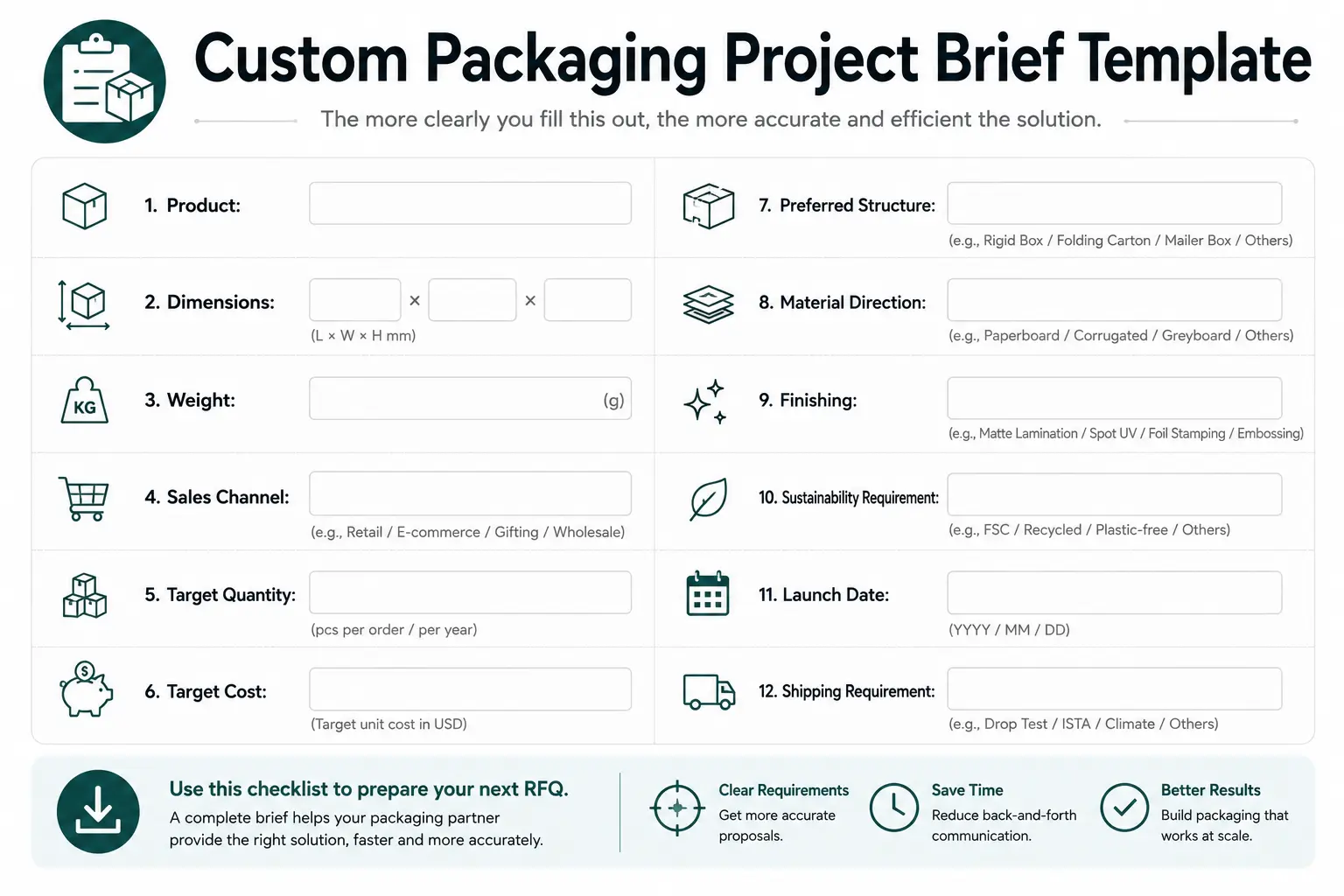
A supplier can’t price “a custom box.” Unit price depends on material usage, machine setup, and run length, so a vague request gets either a wide range or a number that changes after the first revision. The spec sheet is what turns an estimate into a quote you can hold the supplier to.
At minimum, send four things:
- Dimensions: L × W × H, or product capacity (30 ml for a bottle, ounces for a pouch). State whether the figures are inner or outer dimensions, because board thickness sits between the two and affects both fit and price.
- Material: for example 350 gsm paperboard, corrugated kraft, PET, or glass. If you need FSC-certified paper, say so up front, since it affects sourcing.
- Finishes: foil stamping, spot UV, matte or gloss lamination, embossing, window cutouts. Each one adds a process step and setup cost.
- Quantity: your first order volume and an estimated annual forecast. The forecast lets the supplier quote price breaks, even if the first run is small.
If you already have a dieline, artwork, or a reference box, attach it. A quote built on a dieline is far more reliable than one built on a product photo.
Step 2: Read the Three Cost Layers in a Custom Packaging Quote
Most overseas quotes break down into three layers. Knowing which layer a price difference comes from tells you what is actually negotiable.
- Material: the board, film, glass, or other substrate, such as standard paperboard versus a premium textured stock.
- Printing and finishing: machine time, plates, die-cutting, and specialty finishes.
- Logistics and duties: freight, insurance, and import charges, depending on the shipping term in the quote.
Related: how fixed and variable costs show up in a packaging quote
Two Quotes for the “Same” Box Are Rarely the Same Product
A “custom folding carton” can be a lighter board with one-color print, or a heavier board with lamination and a molded insert. Both arrive as a single line on a spreadsheet. Before you compare prices, check that each quote covers the same material, structure, print method, finishes, insert, and packing method. If a line is missing, the lower price may simply be a different box.
The same thing happens inside one brand. A client that runs an IP-themed café in Chicago ordered forks, bags, and takeout boxes carrying the same character. Each item was quoted differently, because the print specifications and spot-color requirements differed from item to item.
Why You Should Ask for Both FOB and DDP Quotes
Ask every supplier for two prices: EXW or FOB, which covers the goods up to the factory or origin port, and DDP, which covers delivery to your door with duties paid.
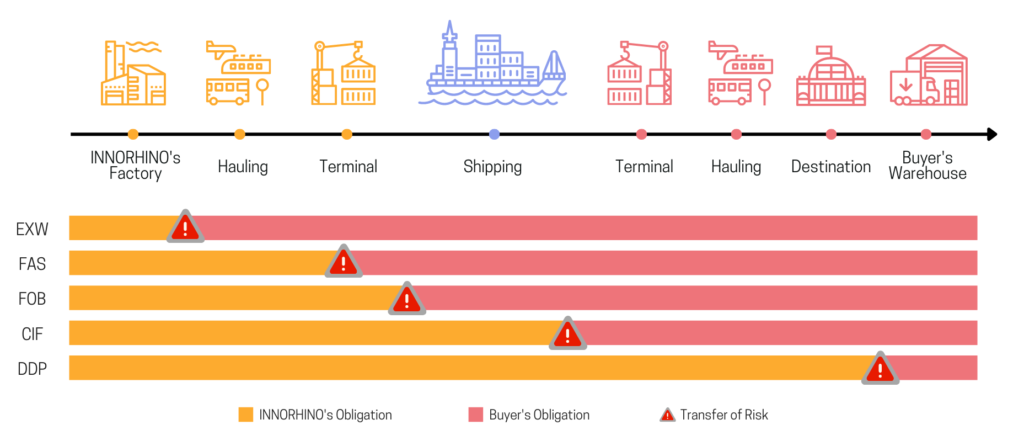
The two figures do different jobs:
- The EXW or FOB price shows the real manufacturing cost. Some suppliers keep the unit price low and recover margin in freight. Comparing factory prices side by side removes that variable.
- The DDP price tests their logistics. Put it next to a quote from your own freight forwarder and you will see who offers the better landed cost.
With DDP, the supplier handles import clearance and pays the duty, so ask which HS code and duty rate the price assumes and how long it holds. US duty rates on packaging have changed several times since 2025, and a DDP price built on an old rate can be revised before shipment. See how US tariffs affect packaging landed cost in 2026.
Compliance note: make sure the quote names the Incoterms® rule, the named place, and the edition, for example “FOB Shenzhen, Incoterms® 2020.” Incoterms® 2020 is still the current edition. A line like “shipping included” does not say who pays destination port fees or who carries the risk during transit. The official definitions are on the International Chamber of Commerce (ICC) Incoterms® 2020 page.
Quick reference: common shipping terms
| Term | Who pays for shipping? | Who pays import duties? | Best for |
|---|---|---|---|
| EXW (Ex Works) | Buyer | Buyer | Buyers with an established freight forwarder |
| FOB (Free on Board) | Supplier to the origin port; buyer from there | Buyer | Brands managing their own sea freight |
| CIF (Cost, Insurance and Freight) | Supplier to your destination port | Buyer, on arrival | Buyers who want the supplier to book sea transit |
| DDP (Delivered Duty Paid) | Supplier | Supplier | First-time buyers who want one door-to-door price |
FOB and CIF apply to sea and inland waterway shipments. Under CIF, risk passes to you once the goods are loaded at origin, even though the supplier pays the freight. For air freight, or for containers handed over at an inland terminal, ICC guidance points to FCA instead of FOB.
What a Packaging Quotation Should Spell Out
Before you compare two quotations, check that each one lists:
- Unit price by quantity tier, so you can see where the price breaks fall.
- One-time costs such as dies and printing plates, quoted separately from the unit price.
- The sample fee, and whether it is credited against the first order.
- The Incoterms® rule, named place, and edition.
- How long the quotation stays valid, and the date from which the production lead time is counted.
If a quotation leaves one of these out, ask for it in writing before you compare totals.
Step 3: Use Sampling to Control Production Risk
Sampling is where a small misalignment gets caught before it becomes expensive to fix. Most projects move through three checkpoints:
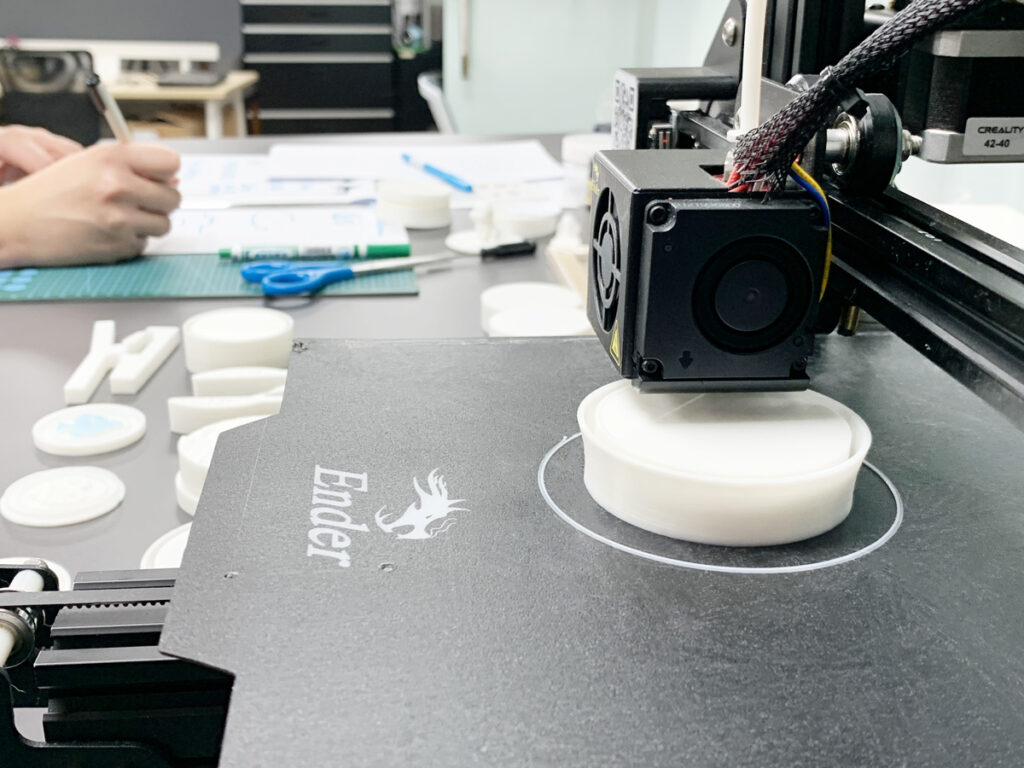
- Dummy sample: a blank prototype to check structure, shape, and whether the product actually fits.
- Digital proof: a file confirming layout, font size, and barcode placement. If brand color is critical, ask for a printed color proof at this stage as well.
- Production sample (golden sample): a fully printed and finished sample made with production materials. Once approved, it is the reference mass production is checked against. Ask for the sample timeline in writing, because it sets when production can start.
Many suppliers charge for custom samples, and some credit the fee against the first production order. Ask how the sample fee is handled before you approve it.
Step 4: Map Out Production and Payment Terms
Once the golden sample is approved, production can start. Agreeing on the timeline at this point is what keeps you from running out of stock. A typical overseas sequence looks like this:
- Final sample approval
- Deposit payment (the share is set by the supplier and is negotiable, so confirm it before you sign)
- Mass production (the lead time the supplier quotes, which depends on structure and finishes)
- Quality inspection and packing
- Balance payment (before shipment or against the bill of lading)
- Shipping
For a closer look at each stage, see how each production stage works, from prototype to mass production.
4 Common Pitfalls When Sourcing Packaging Overseas
A complete spec sheet prevents most problems, but these four still catch first-time buyers.
1. The MOQ Trap (Per Order vs. Per SKU)
- The pitfall: A supplier quotes an MOQ of 5,000 units, and you have five flavors. Later you learn the MOQ was 5,000 per SKU, not for the whole order.
- The fix: Ask whether the MOQ applies per order, per design, or per SKU. For a small test run, ask for the sample MOQ and the mass production MOQ separately.
2. Color That Shifts Between Materials
- The pitfall: Approving a backlit PDF and expecting the printed box to match. Ink sits differently on uncoated kraft than on coated board, so the same file can print noticeably duller.
- The fix: Approve a physical printed sample, either a wet proof or the golden sample, before mass production. If brand colors are strict, specify Pantone (PMS) references rather than relying on CMYK conversion.
3. Lead Times That Ignore Transit and Holidays
- The pitfall: Reading “30 days production” as “arrives in a month.” Transit, port congestion, and factory closures such as Lunar New Year all sit outside that number.
- The fix: Add a buffer of your own to the supplier’s timeline, sized to your selling season, and ask upfront about holidays that fall inside your production window.
4. Paying to Ship Empty Space
- The pitfall: A box designed without its shipping dimensions in mind. Couriers bill by dimensional weight, so a little extra height can move a light product into a higher rate.
- The fix: Ask the supplier to check the dieline against master carton and pallet dimensions before production. Trimming a few millimeters from a non-critical dimension can change how many units fit per carton and per pallet, which lowers freight cost on every shipment.
Case study: The Hidden Freight Trap: How a $0.35 Packaging Saving Cost a Brand $5,950
Three Choices to Reconsider Before You Pay
Ordering more than you can sell to reach a lower unit price adds storage cost and risks a design change. Approving a full-color printed proof before the dimensions are confirmed on a white dummy means paying for a reprint if the fit is off. Adding finishes your budget or use doesn’t justify raises cost without solving a problem you can name. A useful test: if an option adds cost and you can’t say which problem it solves, drop it.
Essential Packaging Glossary for Buyers
- GSM (grams per square meter): the weight of paper or board per square meter. 80 gsm is typical office paper; around 350 gsm is common for a sturdy folding carton. GSM measures weight, not thickness; thickness is specified separately as caliper.
- Die-cut: cutting the material into its final shape with a custom steel-rule die.
- Pantone (PMS): a standardized color matching system used to keep brand colors consistent from run to run.
A clear spec sheet, two shipping terms, and a physical sample approval cover most of the risk in a first overseas order. Before you choose a supplier, it also helps to know how to evaluate custom packaging suppliers before placing an order. If you want sampling handled for you, see our packaging sampling service.
Need a partner to handle the heavy lifting? INNORHINO offers end-to-end custom packaging solutions. Send us your specifications for a transparent, itemized quote.