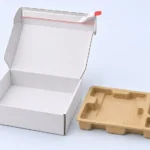
How INNORHINO translated enCore’s dimensional-weight target into a focused box-size recommendation while retaining the existing material specification.
Taking 0.2 inches off one side of enCore’s kit box, from 10.5 × 9.5 × 1.75 to 10.5 × 9.3 × 1.75 inches, brought it under the 173.75 in³ dimensional target that set its Amazon fulfillment fee, without changing materials. Based on enCore’s fee analysis, that saves an estimated US$0.35 per unit, about US$3,500 per 10,000 units.
1. Executive Summary & Key Takeaways
enCore did not simply need a lighter package. It needed a package that remained on the right side of a fulfillment cost calculation.
The decision was whether to approve a controlled reduction in one box dimension, rather than expand the project into a broader material or structural redesign. The objective was specific: reduce the package below the project’s dimensional-volume target while retaining the existing packaging materials wherever practical.
enCore had already reduced the total packaging weight to 333.88 g, or approximately 453.88 g after including 120 g of putty. However, the customer’s analysis indicated that the Amazon fulfillment fee was being driven by dimensional weight rather than actual packed weight. Because the redesign gave every component a fixed place, the first redesigned kit was larger than the original packaging. It measured 10.5 × 9.5 × 1.75 inches, producing a nominal volume of 174.56 in³ and a calculated dimensional weight of approximately 1.256 lb.
The customer therefore established a project target below 173.75 in³, with an estimated potential saving of approximately US$0.35 per unit. INNORHINO translated that commercial requirement into a proposed box size of 10.5 × 9.3 × 1.75 inches, while recommending that the existing materials remain unchanged based on the submitted sample.
At a production volume of 10,000 boxes, the estimated gross fulfillment saving would be approximately:
10,000 × US$0.35 = US$3,500
This is a potential saving based on the customer’s fee analysis. Final savings would still depend on production dimensions, Amazon’s recorded measurements and any implementation costs associated with the change.
Good packaging engineering does not begin by changing more. It begins by identifying which packaging variable controls the cost.

2. Industry Reality & Root Cause Analysis
Packaging cost is not determined by one metric across every sales channel.
For the Amazon channel, enCore’s analysis indicated that dimensional weight was the controlling factor. Further reductions in packaging weight alone would therefore not necessarily change the fulfillment charge.
Shipments from enCore’s own storefront presented a different problem. For those orders, the customer identified opportunities to reduce packed weight by shipping a smaller tray configuration, while also noting a separate dimensional target of 172.8 in³.
Rather than attempting to solve both channel requirements in one redesign, INNORHINO recommended separating the work into two stages:
- Confirm the Amazon packaging configuration first.
- Review the storefront configuration in the next iteration.
In the following iteration, the storefront kit was reconfigured to 428 g, under the 1 lb threshold that drives weight-based parcel pricing. This is estimated to reduce storefront shipping cost by approximately 30–40% per order; actual savings depend on carrier rates and shipping zones.
This sequencing was an important part of the recommendation. Amazon and direct-store shipments were being influenced by different combinations of dimensional volume, actual weight and internal pack configuration. Combining both objectives too early could have increased development scope before the first commercial requirement had been resolved.
For a brand owner, this is the difference between treating packaging as an isolated purchasing item and treating it as part of a fulfillment system.
A single package may serve several sales channels, but those channels do not necessarily reward the same packaging decisions.
3. Engineering & Business Trade-off Analysis
After reviewing the required volume and the existing package format, INNORHINO recommended reducing the 9.5-inch side to 9.3 inches, while retaining the other two dimensions.
The proposed size was:
10.5 × 9.3 × 1.75 inches
The exact nominal volume is:
10.5 × 9.3 × 1.75 = 170.8875 in³
Rounded to two decimal places, this is approximately 170.89 in³.
The revised design would sit approximately 2.86 in³ below the project’s 173.75 in³ target. INNORHINO also identified this as the smallest usable size based on the package under review and recommended continuing with the same materials used in the submitted sample.
The recommendation was deliberately limited. Changing only one dimension reduced the scope of the intervention and avoided introducing an unnecessary material change at the same stage.
The trade-off is that a smaller box provides less internal clearance and less room for production variation. Board caliper, score recovery, folding accuracy, closure bulge and the way the product is loaded can all affect the final external measurement.
A nominal calculation below the target is therefore necessary, but it is not sufficient for production approval.
The revised package should still be checked using representative packed samples. The team should confirm that the dimensional reduction does not:
- create interference between the product and the box;
- distort the closure after packing;
- slow down manual or automated assembly;
- increase damage risk during distribution; or
- allow normal converting variation to push the finished package back above the target.
Crossing a fee breakpoint in a calculation is not the same as holding that breakpoint in production.
4. Practical Recommendation & Decision Gate
The dimensional change should be approved only when the following conditions are met.
| Decision gate | Required input | Decision rule | Action |
|---|---|---|---|
| Dimensional performance | Measurements from representative, fully packed samples | Finished packages remain below 173.75 in³, including normal production variation and an agreed internal safety margin | Proceed to approval; otherwise revise the dimensions |
| Product fit and assembly | Pack-out trial, closure condition and assembly review | No product interference, closure distortion or material increase in packing time | Retain the proposed structure; otherwise reopen the fit review |
| Material performance | Existing board and component specifications | Current materials continue to fold, close and protect the product adequately after the dimensional change | Retain the material specification; otherwise review material or structure |
| Commercial return | Expected order volume, implementation cost and estimated saving | Expected fulfillment savings exceed sampling, tooling, transition and inventory-change costs within the brand’s required payback period | Release the change; otherwise defer or combine it with a later revision |
| Channel sequencing | Amazon and direct-store shipping requirements | Confirm the Amazon configuration first unless one design can meet both channel requirements without compromising the previous gates | Freeze the Amazon version, then reconfigure the storefront version |
This framework protects the commercial objective without assuming that the nominal dimensional calculation alone proves production readiness.
The potential US$3,500 saving at 10,000 units should therefore be evaluated as a gross logistics opportunity. The net project benefit should account for any new sampling, tooling, inventory transition or operational costs required to implement the dimensional change.
5. Consultant’s Note
We often see packaging teams continue removing material after package weight is no longer the variable controlling the fulfillment charge.
In those situations, additional lightweighting can increase structural risk without changing the commercial result. The first task is to identify whether the applicable cost is being driven by actual weight, dimensional weight, size classification, pallet utilization or a combination of these factors.
For the enCore kit, the customer identified the relevant dimensional target. INNORHINO’s role was to convert that target into a specific box-size recommendation, establish which channel should be addressed first and limit the initial change to what was necessary.
The value of the 0.2-inch reduction is not that the adjustment is unusually small. Its value is that it was tied to a defined cost boundary.
The dimensional decision was one part of a wider project. INNORHINO also consolidated six component suppliers into one and moved kit assembly from a US co-packer to its own facility. Finished kits now ship directly to enCore, with one point of contact and one invoice.
A small packaging change creates business value only when it changes the economics of the complete fulfillment system.