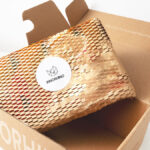
Should your product ship in an open-top HSC, or does it need a fully closed RSC?
Start with an RSC if the case travels through parcel or mixed-freight networks on its own. Choose an HSC when the open top earns its keep: fast top-loading on a packing line, cases that go straight to a store shelf, or parts moving between workstations. Once you add a separate lid, the HSC set usually costs more than the RSC it replaced.
Removing the top flaps takes away little stacking strength by itself, because the side walls carry the load. What it takes away is closure: no dust or moisture barrier, and nothing holding the top edges square when the product can’t support weight. Price the full system, including any lid, tier sheet, and packing labor, then run a compression test and an ISTA test on the packed load before you switch.
A Half Slotted Container (HSC) is a Regular Slotted Container (RSC) with the top flaps removed. Brands and procurement teams usually look at it for one of two reasons: the flaps are slowing down a packing line, or a retailer wants cases that open onto the shelf without a box cutter. The structural change is small. The system change can be bigger, because whatever the top flaps did, something else now has to do.
What Is a Half Slotted Container (HSC)?
In the FEFCO code, the HSC is style 0200 and the RSC is style 0201, both in the 02 series of slotted boxes. The bottom of an HSC is built exactly like an RSC: the minor flaps fold in first, the major flaps meet at the center line, and the bottom is closed with tape or hot melt. The top is a clean cut edge with no flaps and no score line.
An HSC uses the same boards as an RSC, typically single-wall B or C flute or double-wall BC flute, and runs on the same flexo folder-gluer. If you want a refresher on how flute and wall construction change box strength, see which flute profile and board type your box needs.

HSC vs. RSC at a Glance
| HSC (FEFCO 0200) | RSC (FEFCO 0201) | |
|---|---|---|
| Top closure | Open. Needs a lid, tier sheet, or wrap if the top must be covered | Top flaps fold and seal the box |
| Board use | Less board per box | More board for the top flaps |
| Dust, moisture, and tamper protection | None on its own | Basic closure; a taped seal shows if the box was opened |
| Stacking | Close to an RSC when the product or a lid supports the top; walls can bow when the product is soft | Top flaps help hold the walls square |
| Packing and unpacking | Top-load and pick without handling flaps | Flaps must be opened, held back, and sealed |
| Best fit | Telescope bases, shelf-ready cases, in-plant and closed-loop handling | Parcel shipping, mixed freight, export cartons |
Does Removing the Top Flaps Reduce Stacking Strength?
Less than most buyers expect. A corrugated box carries top load mainly through its side walls, and the corners are the strongest points. That is why box compression strength (BCT) is usually estimated from the board’s edge crush value (ECT), its caliper, and the box perimeter. The top flaps are not a major part of that load path.
What the flaps do provide is a closed top that holds the four walls in shape. Without it, the result depends on what is inside. Rigid bottles, cans, or tightly packed cartons that reach the top edge share the load with the walls, and an HSC stacks much like an RSC. Pouches, soft goods, or products with headspace leave the walls doing all the work with nothing tying the top edges together. That is where walls start to bow and top edges roll inward under a full pallet load.
Treat any strength figure on paper as a starting point. The answer for your product comes from a compression test on the packed case and a stacking test on your real pallet pattern. Keep in mind, too, that an HSC offers no dust, moisture, or intrusion protection on its own. It works in a controlled supply chain or when another component covers the top.
Where an HSC Makes Sense
An HSC rarely travels alone through parcel networks. It pays off when the open top saves labor or shelf time, or when another part closes it.
As a telescope base with a separate lid
The HSC becomes the base, and a separate tray-style cover slides over it. FEFCO groups these two-piece designs in its 03 telescope series. The lid lifts off without cutting, which suits heavy or high-value items unloaded by hand, such as automotive parts, server and network equipment, or instruments. The cost is two parts to buy, store, and pair up at packing.
As a shelf-ready case
In grocery and other fast-moving consumer goods, an HSC can go from pallet to shelf with the product already facing out. Store staff skip the box cutter, which shortens restocking and avoids blade damage to the product. If retail-ready packaging is the real goal, compare the HSC with other formats in which shelf-ready packaging format fits your retailer.
For in-plant and closed-loop handling
Between workstations, during harvest, or in returnable loops where boxes never enter a carrier network, the open top speeds up frequent picking and placing, and closure is not needed.
When to keep the RSC
Stay with an RSC when the case ships by parcel, travels with mixed freight, spends weeks in an ocean container where humidity matters, or needs to show it has not been opened. Adding a lid back onto an HSC to cover those needs usually costs more than the top flaps you removed.

>> You may also be interested in Corrugated Half Slotted Container Box (HSC)
What an HSC Really Costs
Box against box, an HSC is priced a little lower than a comparable RSC because it uses less board. That saving is real but small, and it is the only line item that goes down.
Compare the full system instead: the HSC base, the lid or tier sheet if the load needs one, the labor to fit the lid, and the extra SKU in purchasing and storage. With a separate telescope lid, the two-part set usually costs more than a single RSC. The HSC comes out ahead when the open top removes more labor than the lid adds, through faster packing or faster shelf stocking, or when no lid is needed at all.
Two production points shape the quote. A plain HSC runs on the same flexo folder-gluer as an RSC, so it does not need a cutting die. Printed boxes need printing plates, and features like hand holes, vent slots, or a crash-lock bottom need a one-time die. Minimum order quantity follows the corrugator’s minimum run, which is usually set by board area, so a small box needs more pieces to reach it than a large one. For a worked example of how the box choice moves freight cost, see how a lower-priced stock carton raised the freight bill.

How to Decide Before You Switch
Start with the shipping route. If the case moves through parcel or mixed freight, keep the RSC unless something else will close the top. If it moves on pallets through a controlled supply chain, check whether your product can support top load, because that answer decides whether you need a lid, a tier sheet, or nothing at all.
With the configuration settled, price the whole system against the RSC, including the packing and stocking time the open top saves. Then prove it on the real load: a compression test on the packed case, and an ISTA test procedure that matches your distribution, such as ISTA 3E for similar packaged-products shipped as unitized truckloads.
An HSC is the right box when the open top saves more in labor or shelf time than its missing closure costs you. If you are weighing a switch, share your product, pallet pattern, shipping route, and annual volume, and we can compare the two systems with you. Talk with us. Let’s shape it together.
FAQ
Can HSCs be stacked on pallets without a top cover?
Are there tooling costs for HSCs?
Besides heavier board, how can I increase an HSC’s load capacity?
References
- FEFCO (European Federation of Corrugated Board Manufacturers), FEFCO Code: design style library for corrugated board products
- TAPPI (Technical Association of the Pulp and Paper Industry), testing methods and standards
- ISTA (International Safe Transit Association), packaging test procedures