What packaging would an experienced supplier recommend for an herbal supplement?
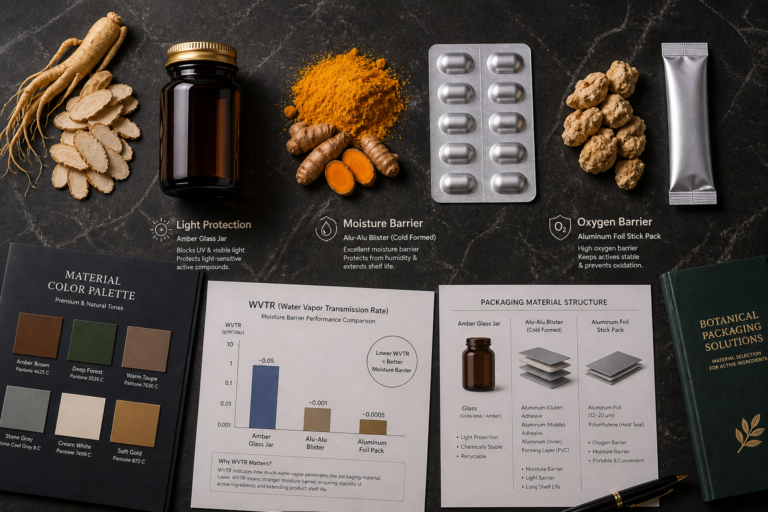
Start from how the formula fails. Moisture-sensitive powders usually start in foil-laminate pouches, with smaller packs or sachets when use stretches over many openings. Capsules and tablets start in a lined HDPE or PET bottle, moving to blisters when each dose needs its own protection. Light-sensitive liquids start in amber glass unless breakage or shipping weight matters more.
Each default trades cost against risk. Smaller packs and blisters raise cost per dose but limit exposure after opening; glass blocks light but adds freight and breakage risk. In our powder projects, poor seals are among the most common causes of moisture damage, so check heat-seal consistency on the filling line before scaling up.
Two herbal powders can share a format and a target shelf life and still need different packaging. If one is hygroscopic and the other isn’t, the pouch that protects the first may be overspending on the second. That’s why the decision starts with the finished formula, not the material catalog.
This guide walks through powders, capsules and tablets, and liquids, then covers what to confirm before you approve a spec: barrier data, food-contact documentation, and stability on the filled package.
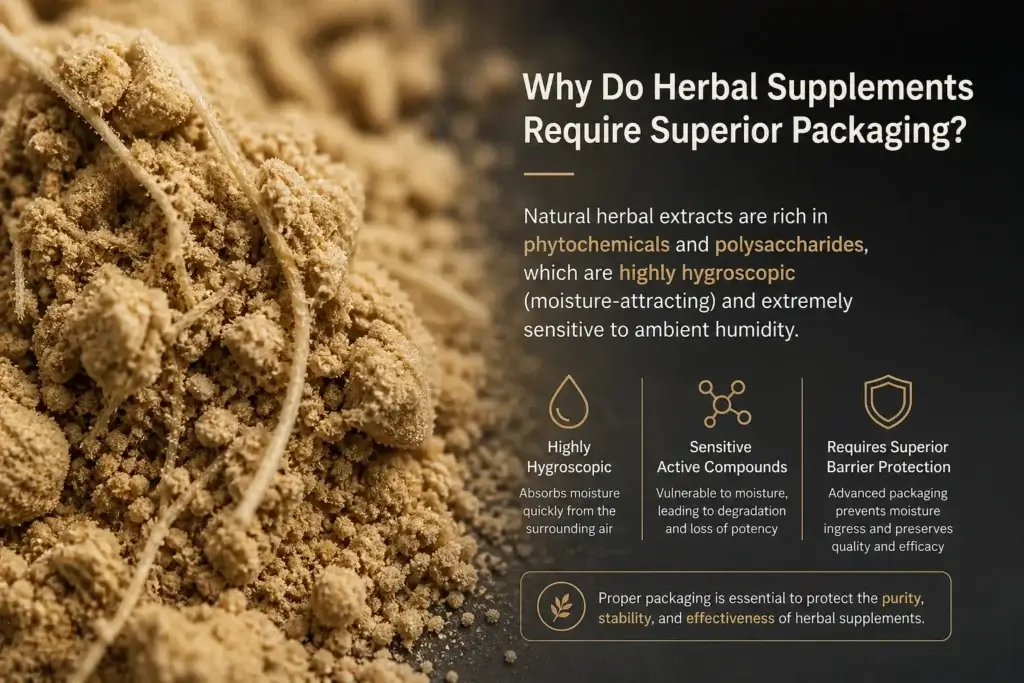
What Herbal Supplement Packaging Needs to Protect Against
Not every herbal supplement needs high-barrier packaging. Botanical ingredients vary widely in sensitivity, so the finished formula and its stability data should set the level of protection. Three risks are worth reviewing with your manufacturer:
- Moisture uptake: Check whether moisture changes the product’s flow, texture, or other quality specifications. Clumping is a quality signal, but on its own it isn’t evidence of microbial spoilage.
- Light and oxygen exposure: If the formula needs protection from either, define which quality attributes the stability study will track.
- Aroma changes: Where aroma is part of the product specification, test both retention and unwanted odor transfer in the proposed packaging.
How to Choose Packaging for Different Supplement Formats
The product format narrows the options, but it shouldn’t decide on its own. Protection needs, filling equipment, shelf life, and how consumers use the package after opening all shape the final choice.
Herbal Powders: Sachets and High-Barrier Pouches
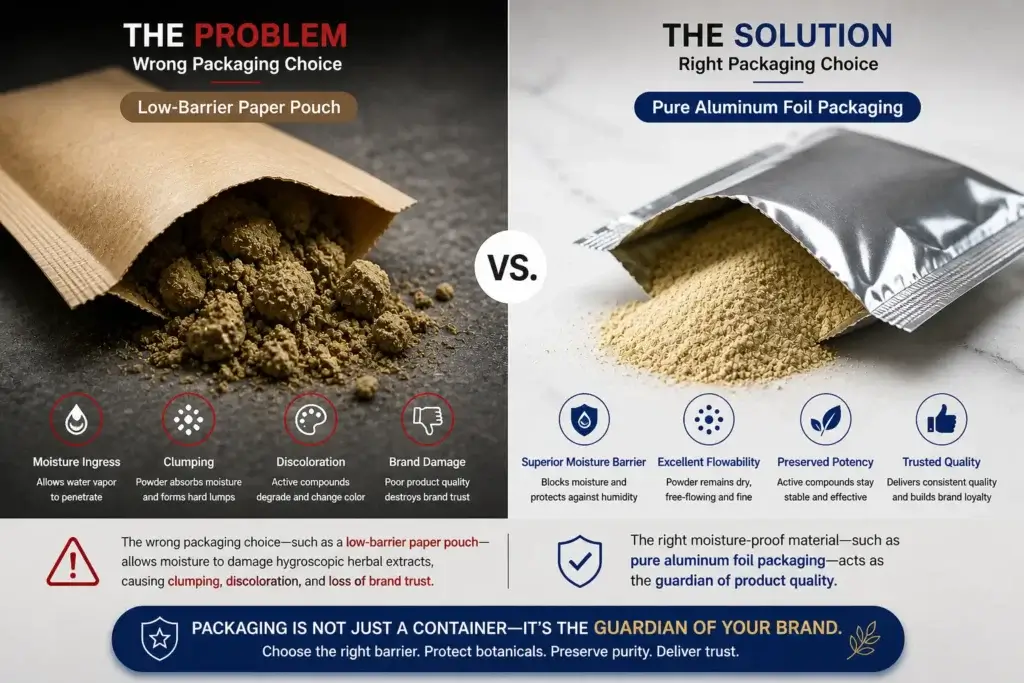
For moisture-sensitive herbal powders, high-barrier sachets and pouches are the usual starting point. Among common flexible structures, foil laminates typically provide the highest combined barrier to moisture, oxygen, and light, as long as the foil layer isn’t damaged by pinholes or flex cracking during converting and handling. Metallized films usually cost less and can work when their barrier data meets the formula’s needs. A silver pouch could be either one, so ask for the layer structure rather than judging by the sample.
Request water vapor transmission rate (WVTR) and oxygen transmission rate (OTR) data at stated temperature and humidity, then run the film on your filling line before committing. A weak seal can undo much of what a high-barrier film provides.
In our powder projects, the two problems we see most often are caking and moisture damage caused by poor seals. A pouch can use a strong barrier film and still let humidity in through a seal that didn’t form completely. And when a large pouch is opened and closed over weeks of use, the remaining powder is exposed again each time.
That’s why we usually raise two questions with powder clients early. First, could the product be split into smaller packs or single-serve sachets, so each opening exposes less powder? Splitting adds packaging units and filling steps, so weigh it against unit cost and line speed. Second, how consistent is the heat-seal yield on the filling line? Dividing the product means more seals per batch, which makes seal quality even more important.
Capsules and Tablets: Bottles vs. Blister Packs
Bottles and blister packs can both work for capsules and tablets. The choice usually comes down to protection after opening, cost per dose, filling-line fit, and freight.
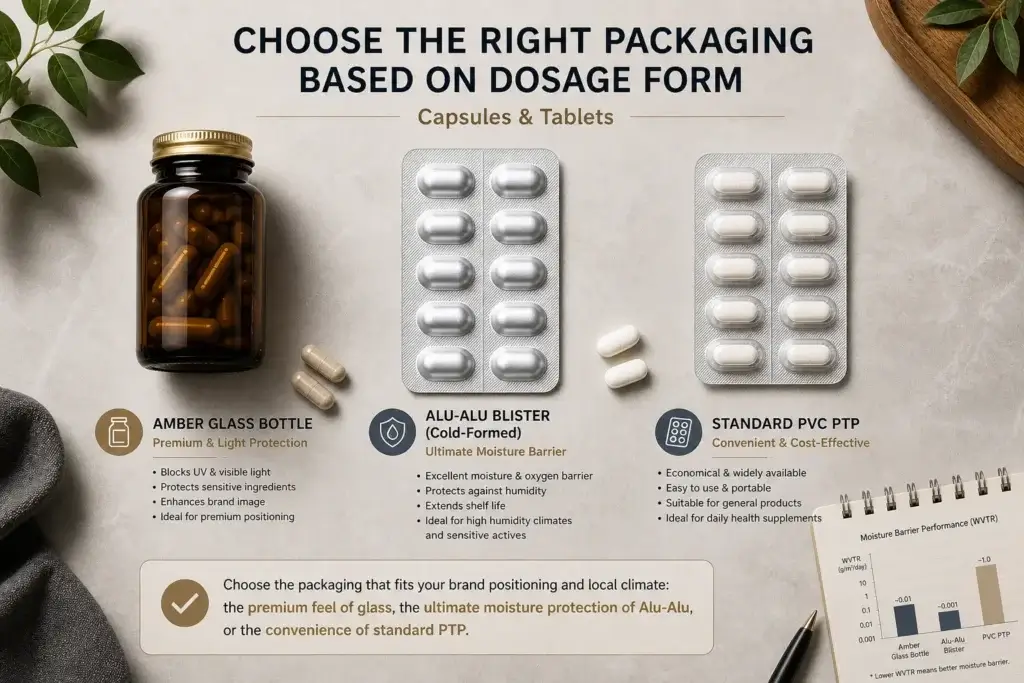
- Glass bottles: A strong barrier with a premium feel, at the cost of weight, breakage risk, and freight. The closure and liner often decide real moisture protection more than the glass does.
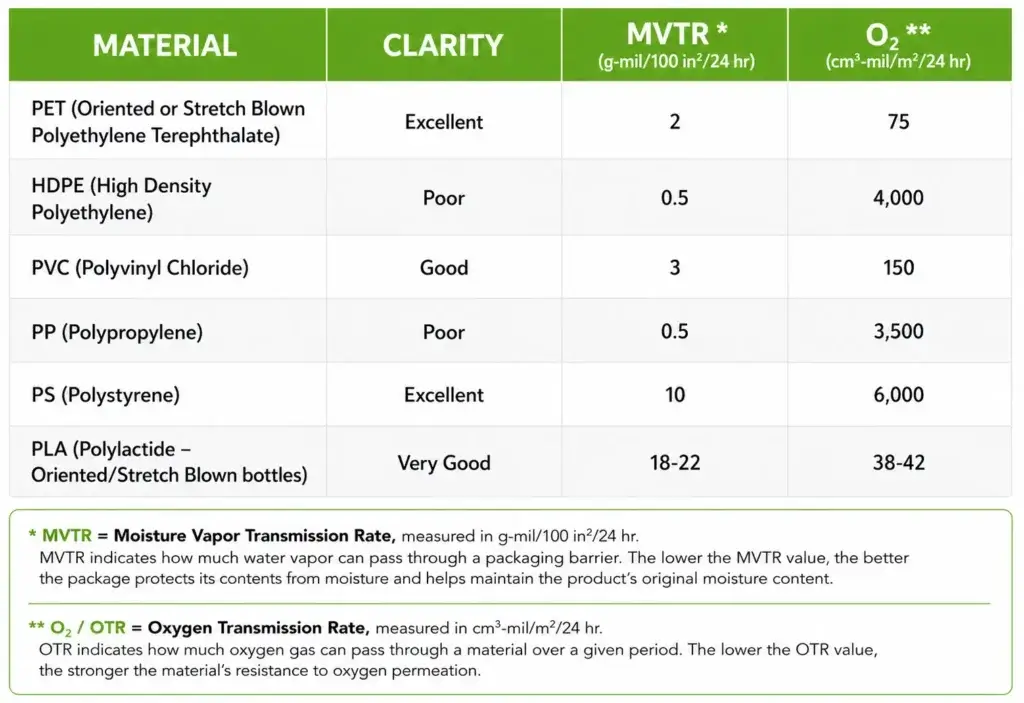
- Plastic bottles: Lighter and more durable. At the material level, HDPE generally transmits less moisture than PET, while PET offers better clarity.
- Blister packs: Each dose stays sealed until it’s used. The barrier depends on the forming film, lidding, and seal working together.
A lined HDPE bottle with an induction seal is a common starting point because it keeps cost per dose low and fits most filling lines. The weak point comes after the seal is removed. Every opening exchanges the air in the headspace, so a large-count bottle used over several months takes in more humid air than a small one finished in a few weeks.
Desiccant is the usual fix, but more isn’t automatically better. Gelatin capsules hold moisture in the shell, and an oversized desiccant can dry them until they turn brittle; HPMC capsules are less sensitive to this. So two questions shape the spec early: how long does one bottle last in use, and what is the capsule shell made of? If the answer points to long exposure or a very sensitive formula, blisters seal each dose and remove the after-opening problem. PVC blisters offer limited moisture protection, while PVDC-coated films and cold-formed aluminum (Alu-Alu) go much further. Alu-Alu cavities need more space per dose, though, which enlarges the card and the carton and raises cost per dose.
Liquid Supplements: Containers and Filling Compatibility
Liquid supplements tend to fail in different ways from powders and capsules: closures that leak in transit, dropper components that react with the base, and botanical aroma lost into the container wall.
Amber glass is a common starting point for light-sensitive liquids. It’s chemically inert, so it won’t take up aroma compounds, and it filters much of the UV that can degrade some botanicals. The cost is weight and breakage, which matter most for direct-to-consumer parcel shipping. Plastic bottles reduce both, but some plastics, polyethylene in particular, can absorb aroma and flavor compounds over time, so compatibility testing with the actual formula carries more weight than it does with glass.
Two questions shape the spec early. What is the base: alcohol, glycerin, water, or oil? Alcohol and essential-oil-rich extracts can swell or degrade some rubber dropper bulbs and liners, so the closure needs the same compatibility check as the bottle. And how will the product ship? Parcel shipping puts more stress on closures than palletized retail, so specify closure torque and liner type and test the filled bottle under shipping conditions. If hot filling or heat treatment is involved, the bottle and closure must also withstand the specified temperatures and cycles; FDA distinguishes food-contact conditions of use, including hot filling and room-temperature filling.
Comparing Herbal Supplement Packaging Options
Use this table to shortlist formats and prepare supplier questions; it compares practical considerations, not measured barrier performance.
| Packaging option | When to evaluate | Main considerations | What to verify |
|---|---|---|---|
| Dark glass bottle | Capsules, tablets, or compatible liquid products | Weight, breakage protection, and closure selection | Light-transmission data, closure integrity, and process compatibility |
| Plastic bottle options | Capsules or tablets where weight and handling matter | Resin, wall thickness, closure, and any desiccant must be specified | Confirm PET or HDPE for the quoted item; validate the complete package |
| Foil-laminate pouch options | Powders requiring evaluation of high-barrier structures | Performance depends on laminate construction and finished seals | Confirm an actual foil layer, barrier test conditions, and seal validation |
| Metallized-pouch options | Powders for which the specified structure meets stability requirements | A silver appearance does not identify the laminate or prove performance | Confirm the film structure, barrier data, and filled-pack stability |
| Blister packaging options | Products requiring individually sealed doses | Forming material, lidding, and sealing process must work together | Confirm primary-blister scope, equipment compatibility, and package integrity |
What Should Brands Verify Before Production?
1. Verify Barrier Performance When Changing Materials
Recyclable, paper-based, and mono-material alternatives can support sustainability goals, but they still have to protect the product. Switching materials can change moisture and oxygen barriers, seal strength, and how the film runs on the filling line. Ask for the complete structure and supporting test data, and check recycling claims against the finished package and the recycling systems in your target market.
2. Confirm Food-Contact Compliance
For products sold in the United States, request documentation identifying the food-contact components and the regulatory basis for their intended use. The review should cover the relevant bottle or pouch materials, closures, liners, and other components that may contact the product. FDA explains how to determine the regulatory status of food-contact components.
That documentation should apply to your actual formulation and conditions of use. A generic “food-grade” statement, or a test report with no clear link to the supplied packaging, won’t settle the question.
3. Validate the Finished Packaging System
Before finalizing packaging, agree on a stability assessment with your supplement manufacturer and quality team. Test the actual formulation in its proposed container, with its closure or seals, under relevant storage conditions and against defined acceptance criteria.
Accelerated testing is useful for comparing options, but a single accelerated study doesn’t guarantee performance across the full shelf life. FDA’s dietary supplement CGMP guidance states that any expiration date used should be supported by data.
Frequently Asked Questions
A: Ask your manufacturer which stock packaging formats work with the formula and filling line. Compare those options with custom packaging using the total order cost, decoration requirements, and available quantities. Confirm MOQ and pricing with suppliers before assuming one format will be the most economical.
A: Review the product’s exposure before sealing, the filling-room conditions, and seal quality with your manufacturer. Set humidity limits around the formula and process requirements rather than a general threshold. If the powder is used over many openings, consider smaller packs so each opening exposes less product, and confirm heat-seal consistency before scaling up. Any formulation changes should be assessed by the team responsible for product development and quality.
A: Blisters keep unopened doses individually sealed, but that does not establish that every blister specification will outperform a bottle. Compare the proposed blister structure and seal with the complete bottle system, including its closure and any desiccant. Use product stability results to support the choice.
Final Considerations
Each starting point above is a trade between cost and risk. Smaller packs and blisters cost more per dose but limit exposure after opening. Glass protects against light at the price of weight and breakage. Larger bottles and pouches keep unit cost down but rely more on the seal, the closure, and your stability data. Move off a default when that data, your filling equipment, or your cost targets point elsewhere.
Need help evaluating packaging for your supplement product? INNORHINO supports packaging material selection, structural design, sampling, and production. Share your product format, expected order quantity, and filling requirements to explore practical packaging options.
Regulatory references checked October 21, 2026. The food-contact discussion above concerns the United States; confirm requirements separately for other markets.