Which compliance documents should you get from a supplement packaging supplier before you compare quotes?
Request five things for the exact components you’re buying: a food-contact compliance statement per material, Prop 65 test data that covers liners, labels, and inks, child-resistant protocol data if your formula requires special packaging, barrier data for the closed package, and a written change-control commitment. An “FDA certificate” or a safety data sheet doesn’t replace any of them.
This applies to bottles, closures, pouches, and stick packs for US retail; printed cartons need their own checklist. Suppliers with complete files may quote higher, but missing paperwork surfaces later as retesting or a stalled retailer onboarding. Check that every document names the material grade and package configuration on your PO, not a product family.
Cross-border packaging sourcing usually fails on paperwork before it fails on quality. A bottle can look right, fit the filling line, and arrive on time, and still leave the brand unable to answer a retailer, an auditor, or a Proposition 65 notice. This guide is for procurement teams that need to screen suppliers on documentation before comparing quotes. It covers primary packaging: bottles, closures, liners, pouches, and stick packs. For printed cartons, see what to ask your supplier about supplement carton compliance. If you are still choosing a format, start with which supplement packaging format fits your formula and budget.
Start with who is responsible for what
Under FDA’s dietary supplement manufacturing rules, the brand or its contract manufacturer must set specifications for packaging that may contact the product (21 CFR 111.70(d)). That packaging must be safe and suitable for its intended use and must not react with, absorb, or otherwise affect the supplement, and the firm that sets the specifications must determine that they are met (§ 111.73). Part 111 applies to firms that manufacture, package, label, or hold supplements, so a bottle or closure maker usually sits outside it. Its documents are what you use to show your packaging specifications were met.
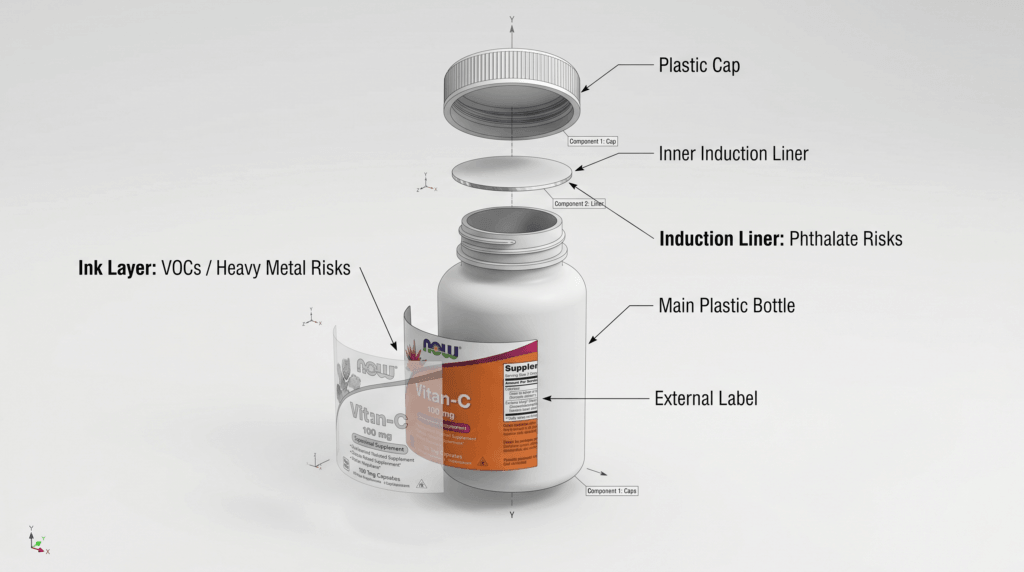
Component compliance doesn’t add up on its own. A compliant PET bottle can ship with a closure liner, induction seal, label adhesive, or printing ink that has no documentation at all. Collect evidence component by component, then check that together it covers the package you will actually ship.
1. A food-contact compliance statement instead of an “FDA certificate”
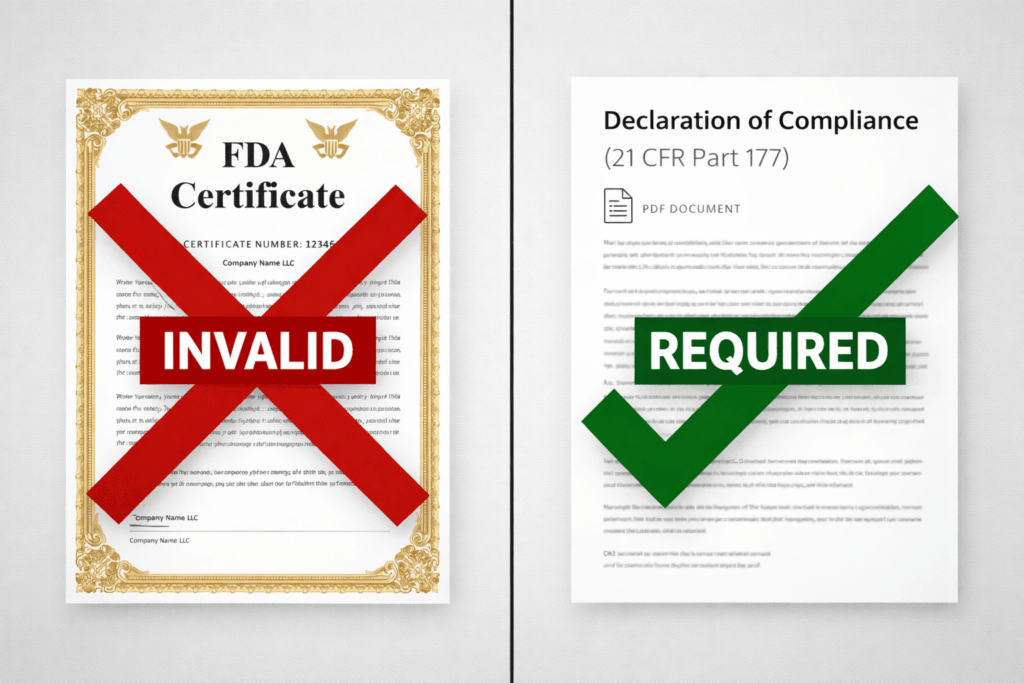
FDA does not certify or approve packaging suppliers, and it does not issue “FDA certificates” for packaging materials. Substances that contact food, including supplements, must be authorized for that use, for example through FDA’s food additive regulations in 21 CFR Parts 174–178, a food contact notification, or another recognized pathway. A document headed “FDA certified” is marketing copy and carries no regulatory weight.
What to request instead:
- A written compliance statement (often called a letter of guaranty or declaration of compliance) for each contact material, naming the resin or material grade and the specific regulation it meets, such as the relevant section of 21 CFR Part 177 for polymers.
- The same for liners, seals, and inner coatings, which are product-contact components too.
- Raw material supplier documents behind the statement, so the chain can be traced if questioned.
A safety data sheet (SDS or MSDS) answers a different question. It covers handling and transport hazards and says nothing about whether a material is suitable for contact with a product people ingest.
2. Proposition 65 and state chemical data for the whole package
California’s Proposition 65 requires a clear warning when a product exposes consumers to listed chemicals above safe harbor levels, unless the exposure is shown to be below them. It is enforced by the state and by private enforcers who send 60-day notices, not at customs. Packaging matters because it can be a source of exposure: plasticizers such as certain phthalates, bisphenol A, and lead in some pigments and inks are listed chemicals.
Ask for test reports from an ISO/IEC 17025-accredited laboratory that cover the listed chemicals relevant to each material, and make sure they include labels, inks, and coatings as well as the bottle resin. Those are the components most often left out. Reports should be recent and match the material grade and colorant you are actually buying.
Proposition 65 is not the only chemical question. Many US states have toxics-in-packaging laws that limit the combined lead, cadmium, mercury, and hexavalent chromium in packaging components, and several restrict intentionally added PFAS in packaging. Ask for a heavy-metal declaration that covers the printed, finished components, and confirm the PFAS rules in each state you sell into.
Whether a warning is needed depends on the finished product and its exposure, so the brand’s own compliance advisor should make that call. Supplier data is the input that makes it possible.
3. Child-resistant protocol data, when your product requires it
Child-resistant packaging is required for specific products under the Poison Prevention Packaging Act. For dietary supplements, the best-known trigger is iron. 16 CFR 1700.14(a)(13) requires special packaging for supplements that contain 250 mg or more of elemental iron, from any source, in a single package, at concentrations of 0.025% or more (weight-to-volume) for liquids or 0.05% or more (weight-to-weight) for nonliquids. Supplement powders with no more than 0.12% elemental iron by weight are exempt. Check your formula against the full list in § 1700.14 rather than assuming.
Where child resistance applies, the package must pass the child test and the applicable adult test in 16 CFR 1700.20. CPSC does not pre-approve designs, and the certification sits with you rather than the closure maker: under CPSC rules, the importer or the domestic party that packages the product issues the certificate of compliance. The supplier’s protocol data is the evidence behind your certificate, so review it with that in mind:
- Check that the report includes both the child panel and the senior-adult panel results. Child data alone is incomplete.
- Check that the tested closure, container size, and neck finish match the components you are buying.
- Prefer reports from an ISO/IEC 17025-accredited lab. Federal rules don’t require third-party testing for special packaging, but accredited data is easier to defend if a retailer or regulator asks.
- Ask for retesting after any change to the closure mold, liner, or container that could affect performance.
- Treat “ASTM D3475 certified” as a red flag. ASTM D3475 classifies child-resistant package types and doesn’t show that a package passed testing.
Tamper-evident features are a separate question. FDA’s tamper-evident packaging rule (21 CFR 211.132) covers OTC drugs, so there is no federal tamper-evident requirement for dietary supplements. Many retailers expect them anyway, so specify them in the purchase order if you need them.

4. Barrier data for the actual container and closure
Moisture and oxygen are the usual stability risks for capsules, tablets, gummies, probiotics, and powders. Ask for moisture vapor transmission rate (MVTR) and, where oxidation matters, oxygen transmission rate (OTR) data for the closed package, not just the resin. Methods such as those described in USP <671> for container performance are a common reference. The data feeds your own stability work rather than replacing it. For probiotics, see how much moisture barrier a probiotic needs before extra CFUs cost more.
| Material | Typical strengths | Watch for |
|---|---|---|
| HDPE bottle | Good moisture barrier; opaque or white options help with light; widely used for capsules and tablets | Lower oxygen barrier than glass; closure and liner choice drive real performance |
| PET bottle | Clarity, good oxygen barrier relative to HDPE, light weight | Moisture barrier usually lower than HDPE; clear bottles offer little light protection |
| Glass (often amber) | Very high moisture and oxygen barrier; amber adds light protection | Weight, breakage, and freight cost |
| Foil laminate pouch or stick pack | High barrier in a light format; good for powders and single doses | Seal integrity and reclosure design determine real-world performance |
5. Change control and site quality
Documents only stay valid if the materials stay the same. Ask the supplier to commit in writing to notify you before changing resin grade, colorant, liner, ink, adhesive, or a sub-supplier, and to keep lot traceability you can request. Site certifications for packaging such as BRCGS Packaging Materials or ISO 22000-based schemes are useful signals of process control. No regulation requires a specific cleanroom class for supplement packaging, so treat cleanroom claims as one factor among several.
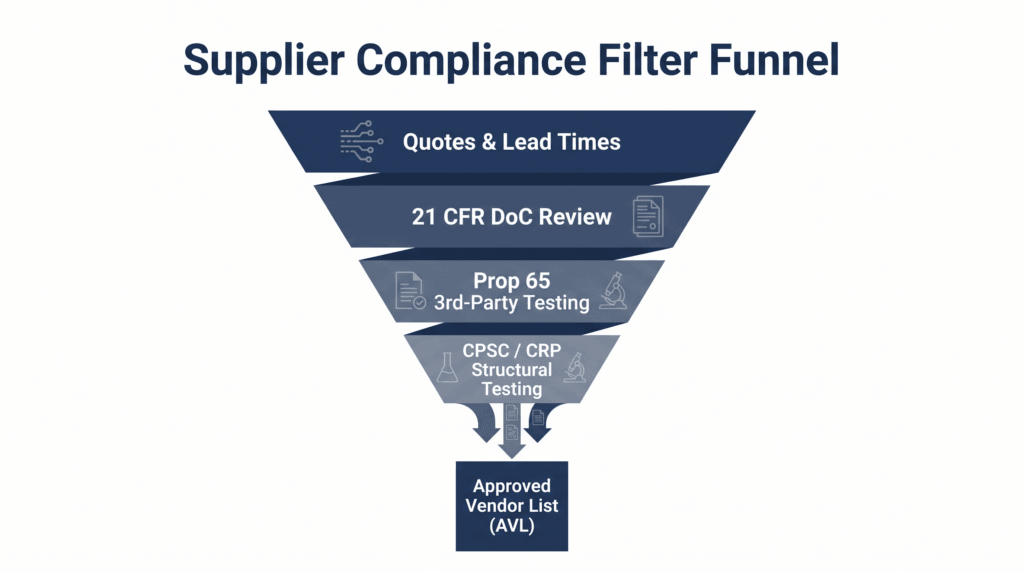
Use documents as the first supplier filter
Screen on documentation before comparing price. If a supplier can’t produce these during quoting, expect the same gaps when a retailer or auditor asks.
| Request | What good looks like | Red flag |
|---|---|---|
| Food-contact compliance | Statement per component naming material grade and regulation | “FDA certified” certificate, or an SDS offered instead |
| Proposition 65 and state laws | Recent accredited-lab reports covering resin, liner, label, and ink, plus a heavy-metal declaration | Generic “BPA free” claim with no data |
| Child resistance (if required) | 16 CFR 1700.20 child and senior-adult data matching your exact closure and container | Report for a different size or neck finish, or “ASTM D3475 certified” |
| Barrier | MVTR/OTR data for the closed package | Resin data only, or none |
| Change control | Written notice before any material or sub-supplier change | Refusal to commit, or “same as before” with no records |
If the documents point to a gap in your current package, see whether to keep, modify, or change your supplement package.
FAQ
Does FDA certify supplement packaging?
Who issues the child-resistant certificate, the supplier or the brand?
Do all supplements need child-resistant packaging?
Do these documents also cover my printed carton?
When does a child-resistant test report stop being valid?
References
- 21 CFR Part 111, Current Good Manufacturing Practice for dietary supplements (eCFR)
- 21 CFR Part 177, Indirect food additives: polymers (FDA)
- Proposition 65 (California OEHHA)
- 16 CFR 1700.14, Substances requiring special packaging (eCFR)
- 16 CFR 1700.20, Testing procedure for special packaging (eCFR)
- U.S. Pharmacopeia, container performance testing <671>
- 21 CFR 111.70, Specifications for dietary supplements, including packaging (eCFR)
- 21 CFR 211.132, Tamper-evident packaging for OTC human drugs (eCFR)
- CPSC Special Packaging (PPPA) FAQ, testing and certificates of compliance
Regulations checked: November 2026.
This article is general guidance, not legal advice. Confirm requirements for your product with a qualified regulatory advisor.
Need suppliers who can answer these questions?
Send us your product format, target components, and the documents your retailers or auditors ask for. We can tell you what documentation is available for each component before you commit to an order.