Start with the market, not the container. The state or country you sell in decides whether packaging must be child-resistant, opaque, or plain, and how much branding you get. Then match the format to the product’s freshness and dosing needs, and commit only when your supplier can document child resistance for the exact components you’re buying.
Exceptions: rules differ by product class, so a jar that works for flower may not work for edibles in the same state. The main trade-off is design freedom versus compliance margin, and child-resistant closures often limit mono-material or recyclable options. Before ordering, check the current regulation text for your market, request test documentation for the full closure configuration, and run a sample fill.
Most cannabis packaging problems don’t come from choosing the wrong material. They come from designing a package for one market’s rules and selling it in another, or from assuming a component is “child-resistant” when only a specific closure-and-container combination was ever tested. This guide walks through the decisions in the order that avoids those mistakes: market, product format, child resistance, design, sustainability, and sourcing.
Start with the market, not the container

United States: state rules still do the heavy lifting
In the U.S., packaging and labeling requirements for dispensary products are written and enforced by each state. Federal status is changing, but it has not replaced state packaging rules. In April 2026, the Justice Department placed FDA-approved products containing marijuana and state-licensed medical marijuana products in Schedule III, and opened an expedited hearing on broader rescheduling that began June 29, 2026. As of September 2026, DEA had not announced a final decision on the broader question. For packaging decisions, treat rescheduling as something to monitor, not a reason to change specs today.
California illustrates what a mature state framework looks like. The state requires child-resistant packaging for all cannabis products, opaque packaging for edibles, the California universal symbol, tamper evidence, and bans packaging that is attractive to children, such as cartoon characters or imitations of candy labeling. It also distinguishes single-use packaging, which is child-resistant only until first opened, from multiple-use packaging, which must stay child-resistant for its lifetime. Other states use different combinations of these rules, so a package approved in one state is a starting point, not a pass, in the next.
The hemp channel is closing on a fixed date

If you sell hemp-derived THC products through convenience, smoke-shop, or e-commerce channels, the packaging decision may soon become a cannabis packaging decision. A federal law signed in November 2025 narrows the definition of hemp to a total-THC standard and caps finished hemp-derived cannabinoid products at 0.4 milligrams of total THC per container. A continuing resolution passed in September 2026 moved the effective date for natural hemp products from November 12 to December 11, 2026, while synthetic products are still prohibited from the original November 12 date. Products that no longer qualify as hemp will need to meet state cannabis rules to stay on the market, which usually means new closures, new labels, or both.
Canada: plain packaging leaves little room for branding
Canada regulates packaging nationally. Immediate containers must be tamper-evident and child-resistant, prevent contamination, keep the product dry, and can be opaque or translucent; containers can’t use embossing, texture, foil, or cut-outs. Packaging must be plain, with limited use of brand elements. A brand coming from a U.S. state with more design freedom will usually need a separate Canadian package, not an adapted one.
Europe: not one market
European rules vary by country, and several markets don’t have commercial retail at all. Germany is the clearest example. Its Cannabis Act does not provide for a retail cannabis market. Non-commercial cannabis clubs may dispense only to members, only in pure form, and advertising and sponsorship are prohibited. If Europe is on your roadmap, confirm the legal channel in each target country before budgeting for branded packaging.
| Market | Child resistance | Visibility of product | Design freedom |
|---|---|---|---|
| U.S. (example: California) | Required; single-use vs. multi-use distinguished | Opaque required for edibles | Moderate; no youth appeal |
| Canada | Required, plus tamper evidence | Opaque or translucent | Very limited; plain packaging |
| Germany (clubs) | Check current rules | Check current rules | Minimal; no advertising |
Match the format to the product
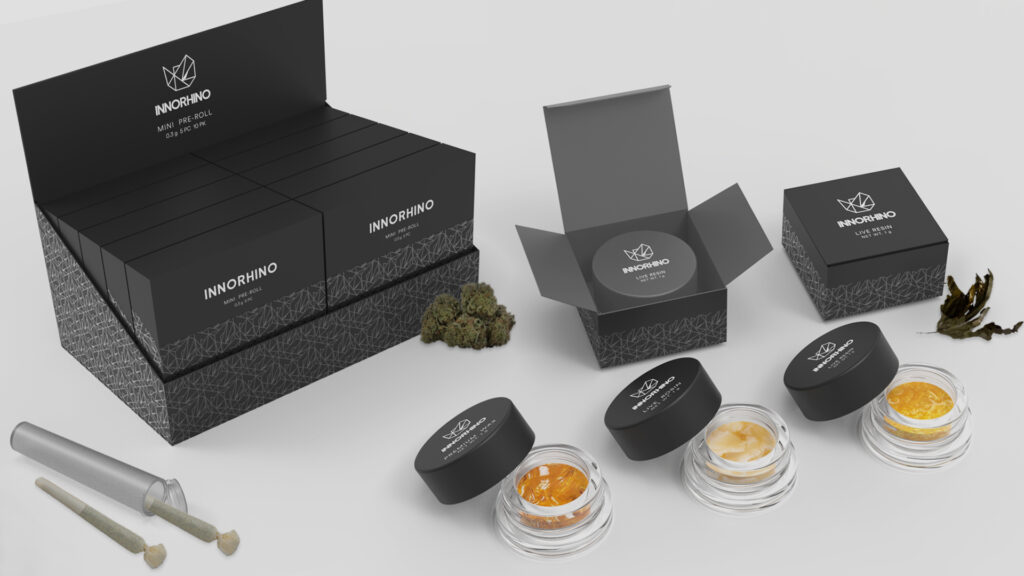
Once the market is clear, the product decides the format. Flower needs a moisture and odor barrier; edibles need food-contact materials and, in many states, opaque packaging; vapes need protection for a fragile hardware component; concentrates need a container that releases a sticky product cleanly.
| Product | Common primary formats | What the package must protect |
|---|---|---|
| Flower | Mylar bags, glass jars | Moisture, aroma, crushing |
| Pre-rolls | Tubes, drawer boxes | Breakage, drying out |
| Vape cartridges | Tubes, blister packs, folding cartons | Hardware damage, tampering |
| Edibles | Resealable pouches, tins, rigid boxes | Freshness, dose clarity, access by children |
| Concentrates | Small glass jars, silicone containers | Stability, clean release |
| Tinctures and capsules | Dropper bottles, plastic or glass bottles | Light exposure, dosing accuracy |
For a format-by-format comparison, see our guide to cannabis packaging options by product type. For flower storage specifically, see How to Keep Your Cannabis Fresh.
Child resistance is a tested configuration, not a feature

A supplier can sell you a “CR jar,” but child resistance belongs to the whole package as tested: the container, the closure, the liner, and sometimes the fill level. Change one component, such as a different cap supplier or a new bottle neck finish, and the original test may no longer apply.
Two decisions come before choosing a component. The first is where child resistance sits: on the primary container, or on a secondary package such as a child-resistant exit bag or carton. Putting it on the secondary package can free up the primary design, but only if your market accepts that approach for your product class. The second is whether the package needs to stay child-resistant after opening. Multi-dose edibles and tinctures usually do; single-serve items may not.
When you request quotes, ask for the test documentation that matches the exact configuration you’re buying, and check which test protocol your state references. A certificate for a similar closure on a different container is not evidence for yours.
Design within the rules

Regulations constrain design, but they rarely eliminate it outside plain-packaging markets. In most U.S. states, the practical limits are youth appeal, required warnings and symbols, and label space. Label space is the constraint brands underestimate most. A small pre-roll tube or 1g jar has to carry the same mandatory information as a larger package, and some states require that information on both the inner and outer layers. Lay out the compliance panel first, then design the brand around it, not the other way around.
Premium finishes such as hot foil, embossing, or holographic film work in many U.S. markets but are restricted in Canada. If you plan to sell in more than one market, decide early whether you want one design with market-specific labels or separate packages. The first is cheaper to run; the second gives you more room in less restrictive markets.
For how packaging design affects shelf performance, see Why Packaging Affects Cannabis Sales.
Where sustainability and compliance pull against each other
Many child-resistant mechanisms combine materials, such as a plastic insert in a paperboard box or a multi-layer film with a zipper, which makes recycling harder. A mono-material design is possible in some formats, but it must pass child-resistance testing on its own merits, so plan for that test in your timeline and budget.
Reusable glass jars appeal to premium buyers, but they add weight and freight cost, and they only reduce waste if customers actually keep them. Recyclability claims also depend on local collection systems, so a material that’s recyclable in one city may go to landfill in another. The most reliable sustainability improvement is usually right-sizing: removing empty space and unnecessary outer layers without touching the certified primary package.
Before you order: a sourcing checklist
- Confirm the market and product class. Pull the current packaging and labeling rules for each state or country you’ll sell in, for each product type.
- Map the mandatory label content. Estimate the panel space it needs before choosing container size.
- Choose the format. Match barrier, dosing, and handling needs to the product.
- Decide where child resistance sits, and whether it must survive repeated opening.
- Request test documentation for the exact configuration you’ll buy. If you change any component later, re-check.
- Order samples and run a real fill. Check seal, odor containment, closure function after repeated use, and fit on your filling line.
- Run a compliance review of final artwork before plates or print files are released.
- Plan for rule changes. With federal rescheduling and the hemp definition both in motion, designs that isolate regulated text on a replaceable label are cheaper to update than fully printed packages.
FAQ
Does all cannabis packaging have to be child-resistant?
Does federal rescheduling change packaging requirements?
What’s the most sustainable cannabis packaging?
Planning a new package or a market expansion?
For regulatory background, see Cross-Border Cannabis Packaging Law: Canada, the USA, and Germany (2026).