Which advent calendar packaging structure should a brand choose, and when should it start?
Choose the structure from what goes inside. Flat, uniform items like chocolates fit a door-style calendar with a formed tray; mixed or fragile items such as glass minis usually need a drawer or book-style box with a custom insert. Then plan backward from your in-store date, because sampling, production, filling, and freight all have to finish before the season starts.
- •Applicable conditions: brands launching a seasonal or promotional calendar with 12 to 25 items, for retail, e-commerce, or corporate gifting.
- •Key trade-off: more premium structures cost more per unit, take longer to fill, and often ship assembled, which raises freight. The filling step, not the box, is where many calendar budgets and schedules slip.
- •Verification step: lock the final item list and dimensions before the insert is designed, then approve a filled sample and run a shipping test before mass production.
An advent calendar is one of the few packaging formats a customer opens a little at a time, every day, for weeks. That is why beauty, food, beverage, toy, pet, and corporate gifting brands use it to introduce product ranges and keep the brand in front of people through a season. It is also why calendars are harder to produce than most gift boxes: two dozen items of different sizes have to fit, stay protected, and come out in the right order. This guide covers the choices that decide cost, schedule, and how the calendar performs in use.
Start with the contents, not the box
Before choosing a structure, list every item that will go inside with its dimensions, weight, and fragility. Three questions come out of that list and drive most of the design:
- How many compartments? 24 or 25 days is traditional, but 12-day calendars cost less, fill faster, and suit higher-value items.
- Are the items uniform or mixed? Identical chocolates can share one cavity size. A beauty calendar mixing lipsticks, jars, and bottles needs cavities sized item by item.
- What can break or leak? Glass minis, liquids, and fragile food need more support between compartments and a structure that holds up to a drop.
Late changes to the item list are the most common cause of delay. If one product is swapped for a larger one after the insert is made, the insert usually has to be redesigned and resampled.
Choose a structure
| Structure | Best for | Main strengths | Watch for |
|---|---|---|---|
| Door-style box with formed tray | Chocolates, small uniform items, value or mid-price lines | Lowest cost per unit; can ship flat or nested; fast to fill when cavities are uniform | Limited protection for heavy or fragile items; perforated doors can be opened in store unless the box is sealed |
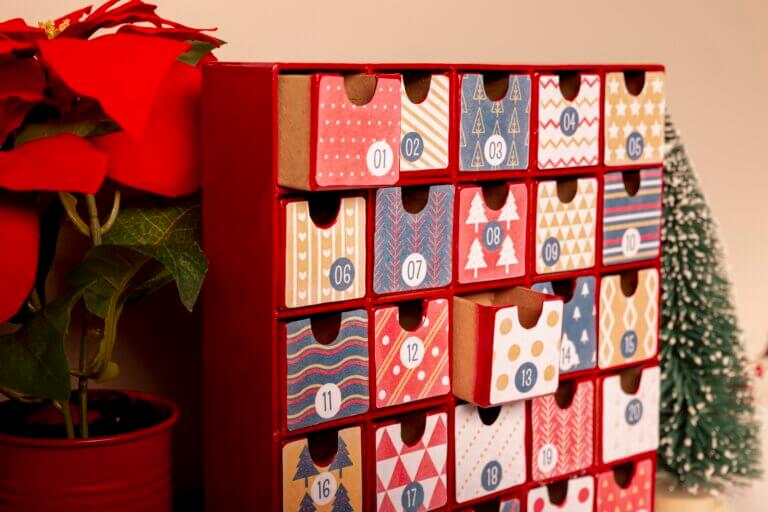
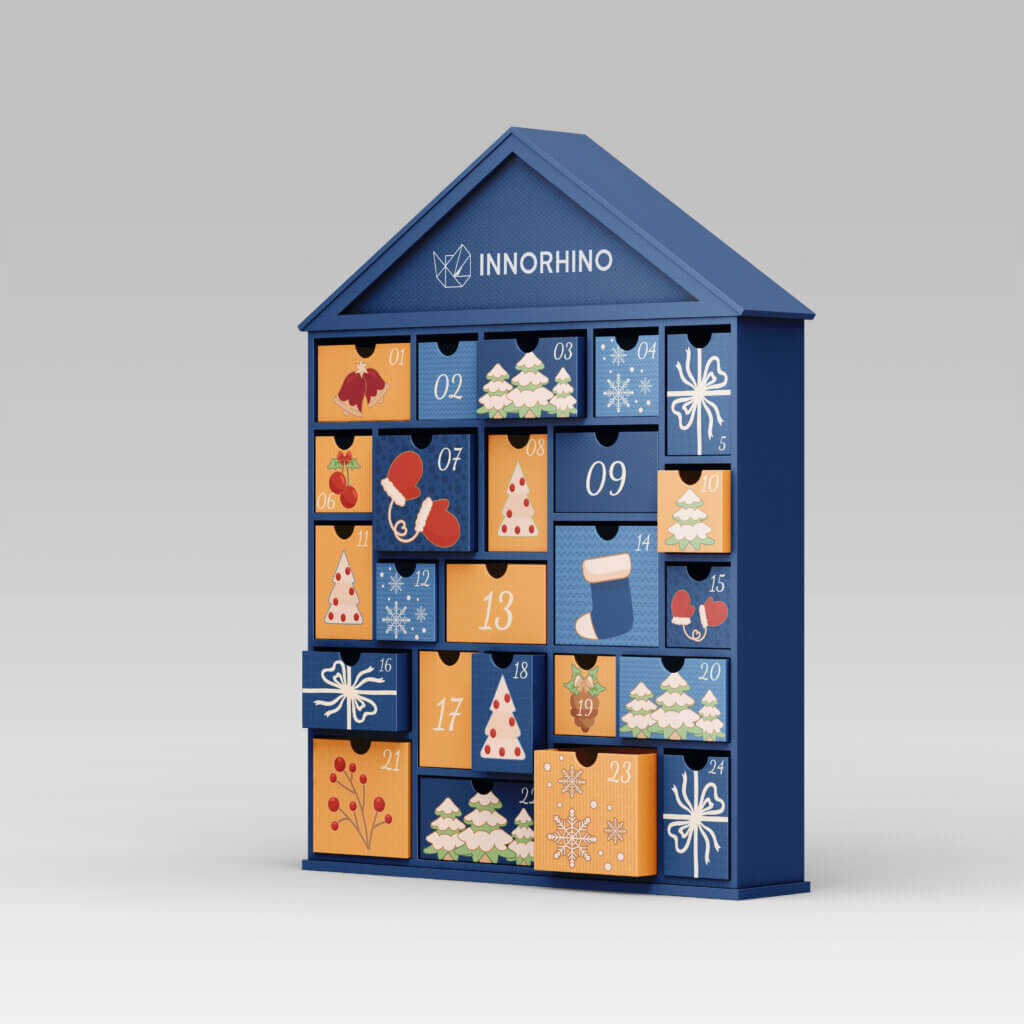
| Drawer calendar (grid of small drawers) | Mixed small items, premium beauty, jewelry, collectibles | Premium feel; each drawer can be sized differently; reusable after the season | More components and assembly; higher unit cost; often ships assembled, raising freight |
| Book-style or lift-lid box with custom insert | Mixed or fragile items, beverage minis, glass bottles | Strong support around each item; large printable surfaces; clear reveal when opened | Rigid set-up boxes take space in transit; insert must match every item exactly |
| Rotary dial, tower, or stacked modules | Display-led campaigns, gifting, limited editions | Strong shelf and social presence | Most complex to engineer and fill; stability in transit needs testing |
Collapsible rigid boxes are worth considering for drawer and book-style calendars. They keep a premium feel while shipping flat, which can reduce freight cost per unit, at the price of assembly time before filling.
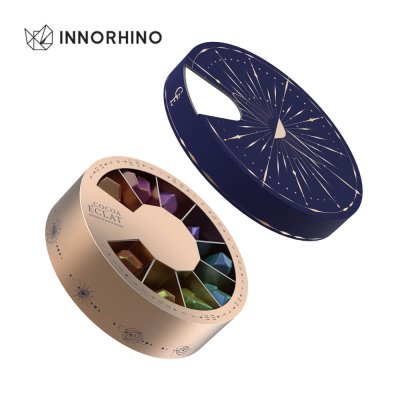
One example of a display-led structure is our round rotary dial advent calendar, originally developed for a premium chocolate brand. The dial turns to reveal one compartment at a time, and the same structure can be built in 24-, 12-, or 10-day versions, so one tooling investment can serve both a holiday calendar and a shorter launch campaign.
Plan the filling step before you approve the design
A calendar is not finished when the box is made. Every unit has to be filled with a specific item in a specific position, and that step often costs more time and money than brands expect. Decide early who fills the calendars: your own team, a co-packer or fulfillment partner, or the packaging supplier if they offer it. Then design for that setting:
- Number or mark each cavity on the insert, not just on the outer doors, so filling mistakes are easy to spot.
- Avoid cavities that are almost the same size but hold different items; they invite mix-ups.
- Build in a way to check a finished unit quickly, such as a fill map printed inside the lid.
- For retail, add tamper evidence, such as a shrink wrap, sleeve, or seal, so doors are not opened before purchase.
Match materials and finishes to the product
For food, especially chocolate, the tray or wrapping that touches the product must be suitable for food contact, and the packed calendar should be protected from heat in transit, since chocolate can soften and bloom. For cosmetics and beverages, insert support and drop testing matter more than finishes.
Paper-based inserts in place of plastic trays make recycling simpler, but they must still hold each item securely; test them with the heaviest and most fragile items, not just the easy ones. Finishes such as foil, embossing, and soft-touch lamination add perceived value, but each adds a production step. Choose one or two that fit your price tier rather than stacking all of them.
Work backward from your in-store date
Calendars are tied to a fixed season, so a late shipment usually means lost sales rather than a later launch. Build the schedule backward from the date the calendars need to be on shelf, in your warehouse, or with your corporate clients:
- Final item list and dimensions confirmed.
- Structural sample with the insert, checked with real products.
- Artwork finalized, including day numbering and any required labeling.
- Pre-production sample approved.
- Mass production.
- Freight to wherever filling happens. Sea freight from Asia to the U.S. alone commonly takes one to two months.
- Filling, sealing, and distribution.
Ask your supplier for a time estimate for each stage based on your structure and quantity, and add a buffer for sample revisions. If your target date is already close, a simpler structure, fewer compartments, or air freight for part of the order can recover time, each at a cost. For many custom projects, the realistic target is next season.
Beyond Christmas
The countdown format also works for product launches, anniversaries, Lunar New Year, Valentine’s Day, and corporate client programs, where each compartment might hold a branded item, sample, or offer. Because these are not tied to one retail season, the schedule is usually more flexible, and the same structure can often be reused with new artwork.
For how the rotary dial calendar was developed for a chocolate brand, see the Cocoa Éclat case study. For choosing finishes by price tier, see Why Your Brand Needs Gift Box Packaging.
FAQ
How many compartments should an advent calendar have?
What is the cheapest advent calendar structure?
Can advent calendar packaging be plastic-free?
Planning an advent calendar?
Send us your item list with dimensions and weights, the number of compartments, your target quantity, the date you need finished calendars in hand, and who will fill them. We can suggest structure options, build a sample with your real products, and tell you which stages are tight on your timeline.