PDQ packaging is a corrugated tray or display that ships already filled with product and goes onto the shelf, counter, or floor with minimal unpacking. It is worth it when your product sells fast, the retailer accepts supplier displays, and the display survives transit without rework. For slow-moving or heavy items, a standard shipper is often cheaper.
- •Applicable conditions: small to mid-size consumer products sold through grocery, pharmacy, convenience, or big-box retail, especially impulse items and launches.
- •Key trade-off: the display saves store labor and adds visibility, but it adds tooling, printing, packing labor, and freight volume on your side.
- •Verification step: get the retailer’s supplier display requirements first, then approve a filled sample and a transit test before production.
What PDQ packaging means
PDQ is usually expanded as “Pretty Darn Quick” or “Product Display Quickly.” Both point to the same idea: the unit that protects the product in transit is also the unit that displays it in store. Instead of opening a shipping carton, pulling out each item, and stacking it on a shelf, store staff remove a lid, hood, or tear-away panel and set the whole tray in place.
Most PDQs are made from corrugated board, printed with brand graphics, and packed at the factory or by a co-packer. The term overlaps with shelf-ready packaging (SRP) and retail-ready packaging (RRP). In practice, PDQ often refers to the smaller counter and shelf trays, while larger floor and pallet units are called displays, but retailers and suppliers use the words loosely. You will also see the same thing called a PDQ box, PDQ tray, or counter display box.
Who benefits, and how
For retailers, the main gain is labor. A PDQ goes from backroom to shelf in one move, restocking is faster, and the shelf stays neat because each product sits in its own slot.
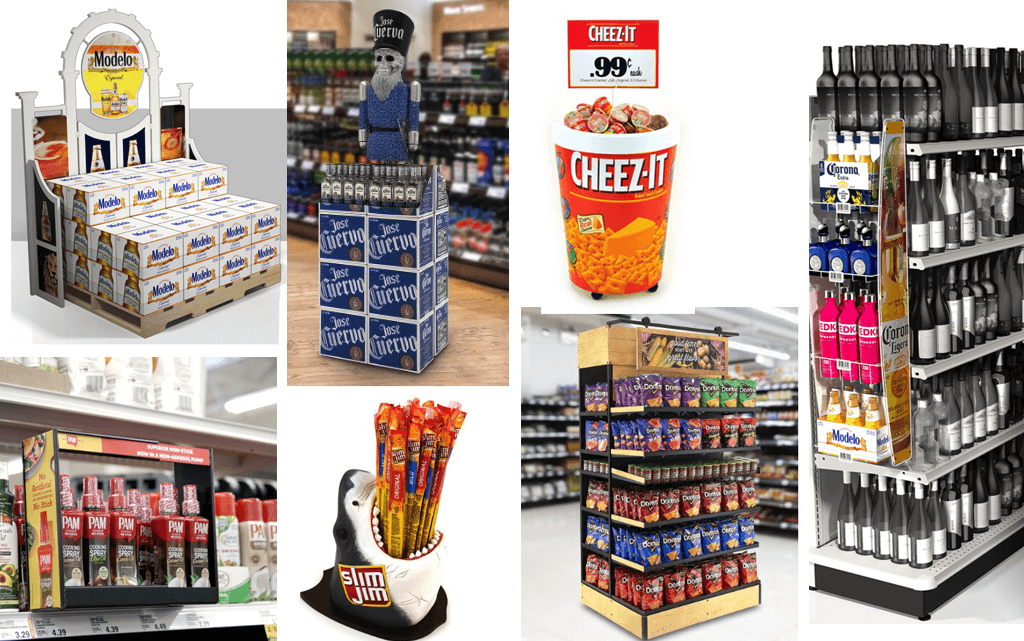
For brands, the gain is presence. The tray gives you a printed header and front panel that a loose product on a shelf does not have, and it lets you place product in spots that shelves do not reach, such as the checkout counter or an endcap. It is also a practical way to introduce a new SKU, because the retailer receives a complete, ready-to-sell unit.
Choose a format by placement
| Format | Typical placement | Good fit for | Watch for |
|---|---|---|---|
| Countertop tray | Checkout, pharmacy counter, service desk | Lip balm, stick packs, bars, batteries, small impulse items | Counter space is limited and often controlled by the retailer; keep the footprint small |
| Shelf-ready tray | Regular aisle shelves | Bottles, cans, boxed tea, personal care | Must match the retailer’s shelf depth and height, and still let shoppers pull product out easily |
| Sidekick or clip-strip display | Hung on the side of an endcap | Light accessories, trial sizes, seasonal add-ons | Weight limits on the fixture; depends on the store’s fixture type |
| Floor or pallet display | Warehouse clubs, center-store promotions | High-volume items, multipacks, seasonal programs | Largest investment; needs stacking and load testing, and pallet placement is usually negotiated with the retailer |
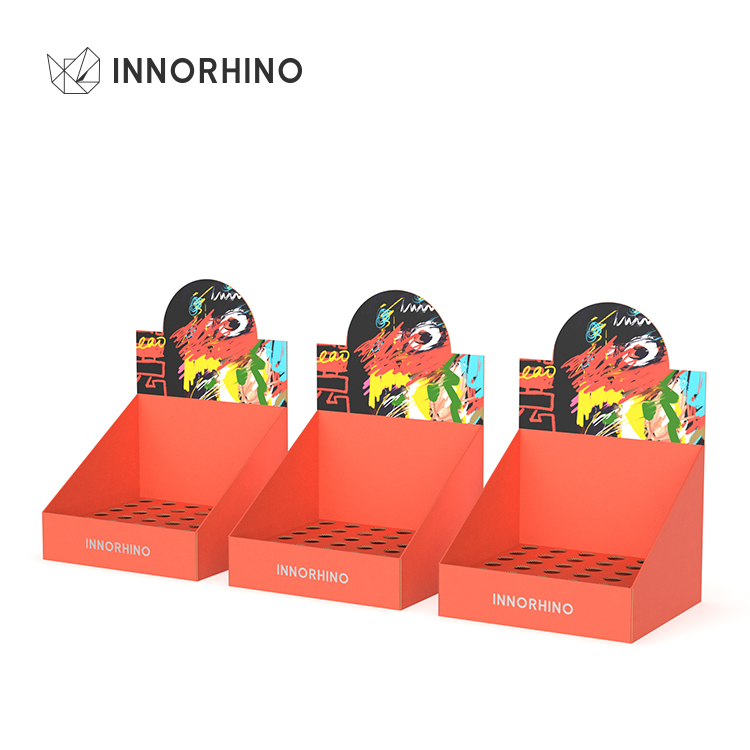
For an example of a counter-style corrugated display, see our PDQ display structure.
Design for the retailer’s rules first
Large retailers publish supplier requirements for displays and shelf-ready packaging, and a display that does not meet them can be rejected or charged back. Requirements differ by retailer and change over time, so get the current version from your buyer before design starts. The points that come up most often:
- Easy opening. Staff should be able to open the unit quickly by hand, without a box cutter that could damage the product. Perforated tear-away fronts, lift-off hoods, and removable caps are the usual answers.
- Dimensions. The tray has to fit the shelf, counter, or fixture it is meant for, including height clearance.
- Board strength. The corrugated grade, commonly specified as an ECT rating such as 32 ECT or 44 ECT, or a burst rating such as 200# test, has to carry the product weight and survive stacking in trucks and warehouses.
- Transit testing. Many retailers expect packed displays to pass a transit test such as an ISTA procedure. Which procedure applies depends on how the unit ships, so confirm it rather than assuming.
- Identification. Barcode placement, case labeling, and orientation marks, so the unit can be received and scanned.
Where the cost comes from
A PDQ program costs more than the tray itself. When you compare it with a standard shipper, count:
- Tooling and sampling for a custom die line.
- Printing, which grows with the number of colors, the print method, and how many retailer versions you need.
- Packing labor, because each product has to be placed in the tray, at the factory or at a co-packer.
- Freight volume. A display tray usually takes more space per unit than a plain carton, so freight per unit can rise.
These costs are easier to justify when the product turns quickly and the display earns a placement you would not otherwise get.
When a PDQ is not the right choice
- The product sells slowly, so a tray sits half-empty and looks neglected.
- The items are heavy or fragile enough that corrugated trays need heavy reinforcement.
- The retailer does not accept supplier displays in that category or controls all fixtures itself.
- You sell mainly online, where the display never gets seen.
Make the display sell, not just hold
- Keep the header readable from a distance. Brand, product, and one clear message; shoppers see a PDQ for a few seconds.
- Design for the half-empty tray. Once product sells down, the inside of the tray is exposed, so print it too.
- Pair related products when the retailer allows mixed trays, for example a bar with a drink, to raise basket size.
- Help the store set it up correctly. A simple setup instruction, placement photo, or planogram reference reduces displays left in the backroom.
The assortment inside the display can matter as much as the graphics. In a 2023 sponsored article, Hershey reported that its modular “agile” displays, which vary the brand mix and box counts by store, averaged a 5 to 10% increase in sell-through compared with its traditional one-size displays (Grocery Dive, sponsored by Hershey). That is one company’s own figure, not an industry benchmark, but it shows the lever: a display filled with what a specific store actually sells tends to empty faster.
Start with a small pilot
- Pick two or three fast-moving SKUs and one placement type.
- Get the retailer’s display requirements and design to them.
- Approve a filled sample and run a transit test.
- Run the display in a limited number of stores and track sell-through, restocking frequency, damage on arrival, and how many units were actually set up on the floor.
- Adjust the structure or graphics, then scale.
FAQ
What does PDQ stand for, and what is a PDQ box?
What is the difference between PDQ and shelf-ready packaging?
Is PDQ packaging recyclable?
Which products work best in PDQ displays?
Small, fast-selling items that shoppers pick up on impulse or try for the first time: snacks, confectionery, beauty and personal care, supplements, batteries, and small accessories.
Planning a PDQ display?
Send us your product dimensions and weights, units per tray, target retailer and placement, and any supplier requirements you have received. We can suggest a structure, build a filled sample, and help you check it against the retailer’s rules before production.