 Skip to content

INNORHINO Packaging Insight
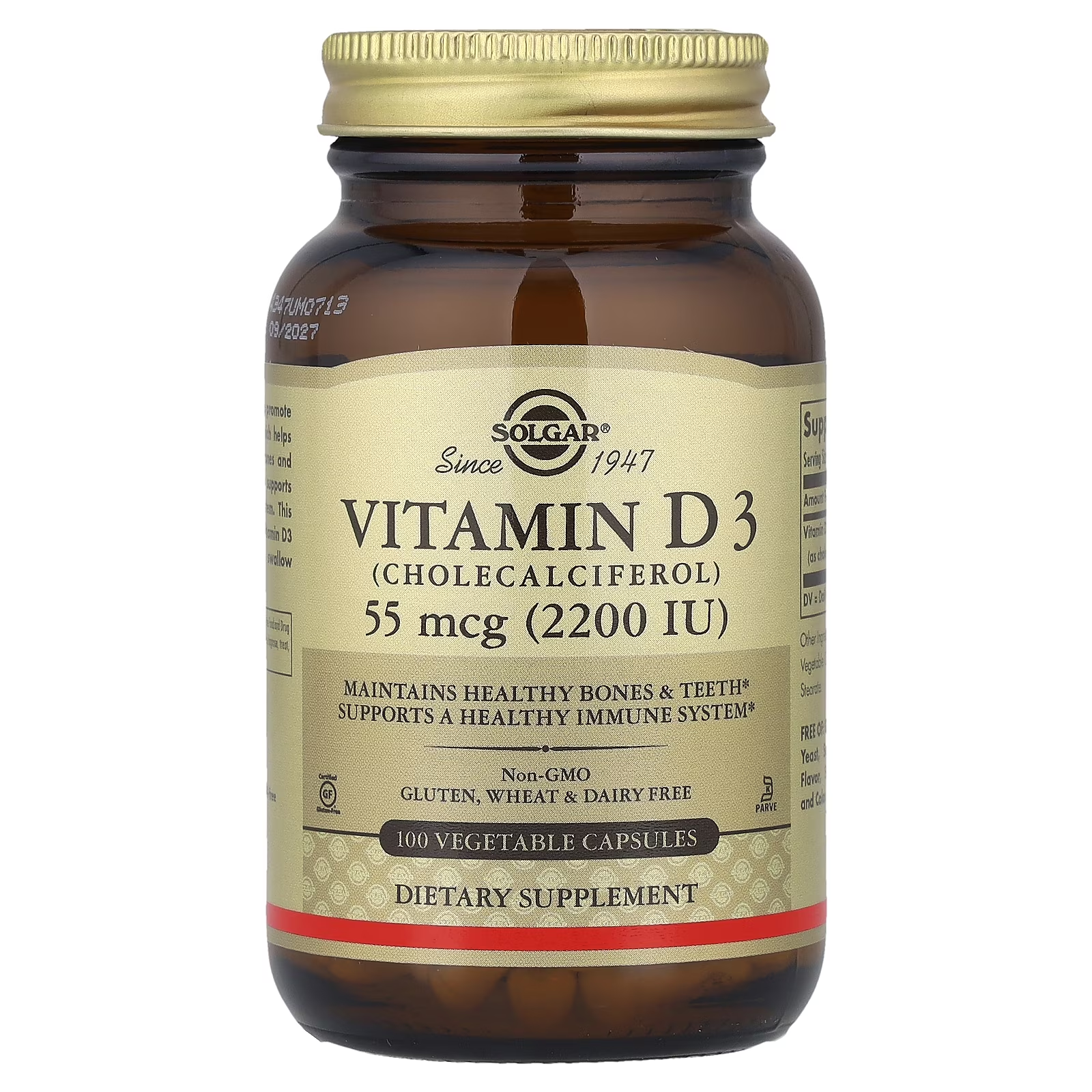
On the supplement shelf, Solgar’s amber glass bottle and gold cap usually get tagged as “retro” branding—a nod to the old-school apothecary. But to a packaging engineer, that aesthetic argument misses the point. This isn’t just nostalgia; it is a calculated fortress built to defend the biochemical fragility of Omega-3s.
Strip away the marketing, and you find a preservation system that prioritizes thermodynamics over supply chain efficiency. Solgar is essentially selling an oxygen-insulated vacuum, and they are paying a premium to do it.
About Solgar
Solgar is a premium American manufacturer of high-quality nutritional supplements founded in 1947 and based in Leonia, New Jersey. Known for its “Gold Standard” of quality, the brand produces over 450 products—including vitamins, minerals, and herbs—sold in eco-friendly amber glass bottles to protect against light and oxidation.
The Glass Wall: A Long-Pass Filter for Photons
The modern industry default is HDPE or PET. The logic is sound: they bounce when dropped and cost pennies to ship. But for fish oil rich in EPA and DHA, plastic has a fatal microscopic flaw—Free Volume. No matter how advanced the multi-layer co-extrusion gets, polymer chains have gaps. Gas molecules inevitably drift through.
Solgar sticks with amber glass because of its lattice density. As an inorganic, amorphous solid, glass has an Oxygen Transmission Rate (OTR) that is effectively zero. Once capped, it’s a nitrogen vault.

The more critical factor is light. The oxidation “initiation phase” in lipids is triggered by photon energy. Clear glass is useless against UVA; standard green glass is weak. Solgar’s deep amber acts as a high-performance long-pass filter. It aggressively blocks the 290nm-400nm UV range and cuts out high-energy blue light (under 450nm). This stops photosensitizers (like trace chlorophyll) from kicking off the free radical chain reaction that turns oil rancid.


The Metal Cap Paradox: Fighting Induction Physics
The gold metal screw cap is the most interesting piece of engineering here because, operationally, it shouldn’t exist.
In a standard packaging line, metal caps and Induction Sealing are enemies. The process uses a magnetic field to heat the foil liner inside the cap. But when the cap itself is conductive (tinplate or aluminum), Faraday’s Law of Induction kicks in. The cap acts as a giant conductor, sucking up the magnetic energy and creating Eddy Currents.
The usual result? The cap gets scorching hot, dangerous to touch, while the liner inside stays cold. Or worse, the heat radiates down and melts the bottle threads.
The fact that Solgar runs this at scale means they solved the thermodynamic conflict. This requires a specific, painful set of adjustments:
- Ferrite Flux Concentrators: They likely use custom sealing heads that force the magnetic field to tunnel directly into the center of the foil, bypassing the metal skirt of the cap.
- The Lift ‘n’ Peel™ Buffer: Look at the liner. That polyester tab isn’t just for easy opening; during sealing, it acts as a thermal insulator, creating distance between the hot induction foil and the conductive metal cap.
- Active Cooling: You can’t just pack these into boxes immediately. The line requires a cooling tunnel to strip heat from the metal cap before it cooks the softgels inside.
It’s a massive hassle. But it’s the only way to get the “cold metal” premium feel without sacrificing the hermetic seal.

The Logistics Penalty: Purity vs. Payload
If you look at this through a Life Cycle Assessment (LCA) lens, Solgar is rebelling against lightweighting trends. Glass density is roughly 2.5 times that of HDPE. The carbon footprint from transport spikes. You have to over-engineer the secondary packaging—thicker corrugate, more cushioning—just to stop the bottles from shattering in transit.
Solgar accepts this penalty for one reason: Inertness.
Fish oil is a lipophilic solvent. Stored in plastic for two years, there is a theoretical risk of monomer migration or plasticizer leaching. Glass eliminates that variable entirely. It offers a “non-leaching” guarantee. When the selling point is “pure health from the ocean,” you cannot risk the packaging becoming part of the ingestible product.
The Semiotics of the “Clink”
We have to acknowledge the sensory engineering. The design leverages the psychology of the “Apothecary.”
- Tactile: The thermal conductivity of the metal cap makes it feel cold to the touch. The bottle is heavy. These signals scream “freshness” and “potency” to the reptilian brain.
- Auditory: The distinct clink of softgels hitting glass sounds pharmaceutical. Plastic thuds; glass rings.
- Visual: The semi-transparency allows inspection. You can see if the capsules are clumping or discolored. A fully opaque plastic bottle hides the product, asking for blind trust. Solgar’s glass offers verification.

The Verdict
Solgar’s packaging isn’t an artifact; it’s a tank. It uses material physics to halt oxidation kinetics and complex tooling to bypass production limitations. It is a logistical nightmare compared to a plastic tub, but for a brand that treats TOTOX (Total Oxidation) values as religion, it is the only valid engineering choice.
FAQ Section
A: It’s a trade-off between logistics and chemistry. While glass spikes shipping weight and carbon footprint, it provides a “Zero Oxygen Transmission Rate” (OTR) that plastic cannot match. Plastic polymers have “free volume” that allows gas exchange over time. For fish oil, which goes rancid easily, glass ensures the product stays chemically stable throughout its shelf life.
A: This is a major production challenge. Since metal caps conduct electricity, standard induction sealers heat the cap, not the foil. Solgar likely uses “Flux Concentrators” to focus magnetic energy solely on the center of the foil, along with specialized liners (like Lift ‘n’ Peel™) that act as thermal buffers to protect the seal integrity.
A: No, it’s a functional filter. True amber glass uses sulfur and iron chromophores to block light wavelengths below 450nm (UV and high-energy blue light). This prevents “photo-oxidation,” where light energy excites the oil molecules and triggers free radical production. Green or clear glass does not offer this specific spectral protection.
A: Absolutely. Aside from oxidation protection, glass is chemically inert. Fish oil is a solvent; in plastic containers, there is always a minor risk of “leaching” (compounds migrating from the plastic into the oil). Glass eliminates this risk, ensuring the purity of the dosage.



